Best Time to Post Content: A Practical 2026 Guide
13 min readbest time to post contentsocial media schedulingposting timecontent calendar

You've scheduled a post for the hour a popular chart calls “best.” Your audience is spread across several time zones, the content is a detailed product explainer, and the post goes live while most of your intended readers are offline. The chart looked precise. The decision wasn't.
There's no universally reliable best time to post content. The useful answer depends on who you're trying to reach, where those people are, what the content asks them to do, and how it's distributed. Treat timing as a testable part of your publishing strategy, not a magic hour to copy.
Table of Contents
- Why Generic Best Time Charts Usually Fail
- The Three Layers That Decide Effective Posting Time
- What the Research Says About Timing
- Designing a Timing Experiment You Can Trust
- Matching Schedule to Audience Geography and Format
- Organic Reach Versus Paid Amplification Timing
- Metrics That Confirm Timing Decisions
- A 30-Day Plan to Find Your Best Posting Windows
Why Generic Best Time Charts Usually Fail
A chart recommends Tuesday at 9 a.m. Another recommends Thursday evening. Both can cite platform data, yet neither knows whether your audience spans three time zones, whether the post is a short video or a detailed explainer, or whether the goal is comments rather than clicks. Treat the recommendation as a starting hypothesis, not account-level instruction.
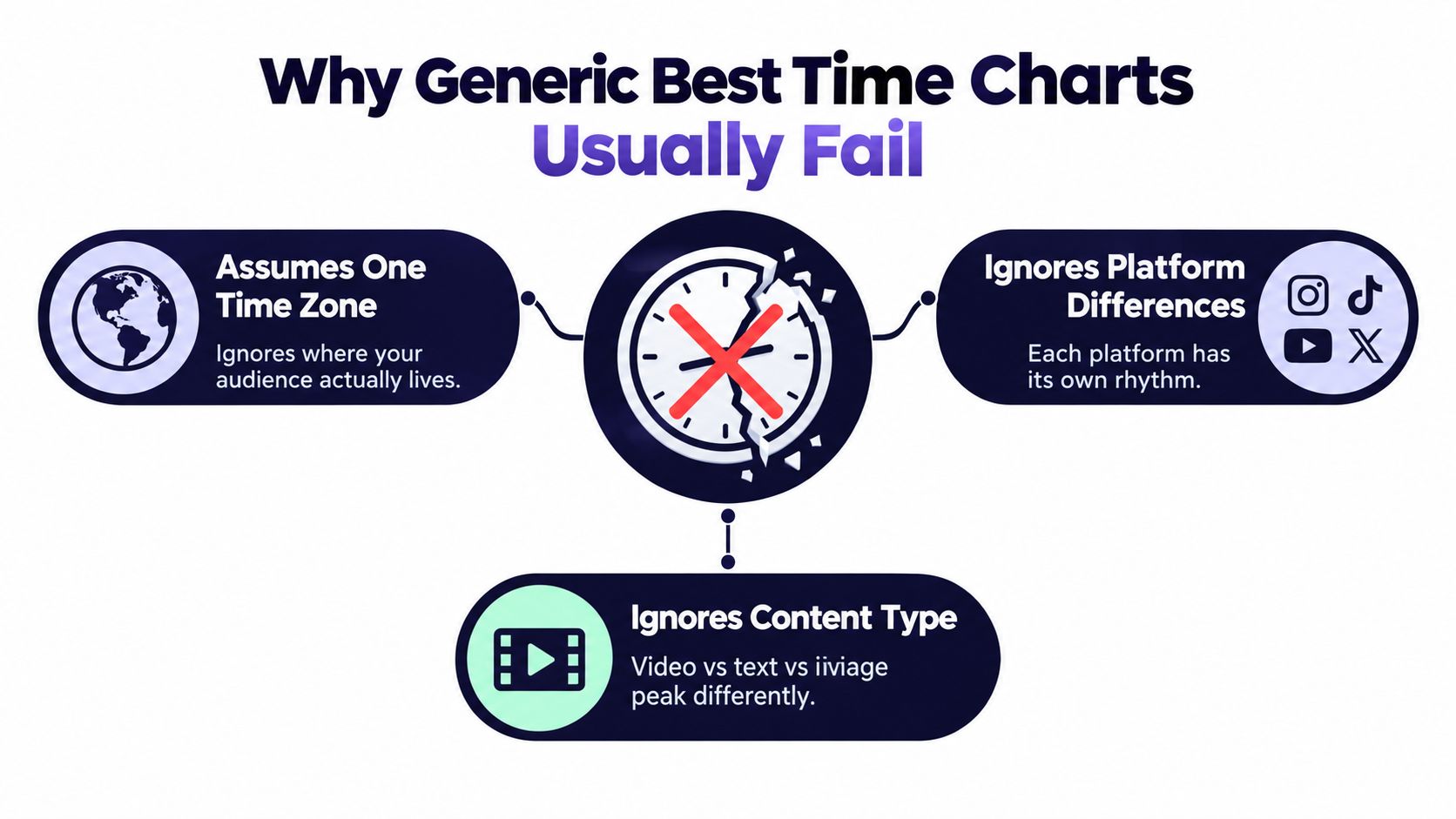
Audience availability is a more useful first signal than a universal hour. Pew Research Center found that 70% of U.S. Facebook users visited Facebook daily, including 49% who visited several times per day, in its 2021 study of social media use (Pew Research Center's findings on social media use). Those repeated visits create several possible exposure windows.
Frequency alone still leaves the timing question unresolved. A daily user may check a feed during a commute, a lunch break, and late evening, with different attention available at each moment. Publishing while that person is active may create an opportunity for interaction, but it does not guarantee interest in every format or objective.
Averages hide the audience you need
Benchmarks can point in opposite directions because they often measure different audiences, platforms, and definitions of success. One set of Instagram findings highlights morning activity, while another reports stronger evening performance. Neither result settles the question for your account.
The stronger test is whether a time window produces the action attached to the post. Likes can show that content was noticed. Comments, shares, clicks, and conversions provide clearer evidence that timing supported its purpose.
Generic charts usually fail because they flatten those variables into one answer. Their real value is narrower: they can suggest a plausible window for your own account data to confirm or reject.
The Three Layers That Decide Effective Posting Time
A post needs to clear three practical hurdles before its scheduled time can help: audience activity, platform norms, and format-objective fit. Think of a neighborhood coffee shop. The best time to open depends on when customers pass by, what the shop can serve quickly, and whether people want a takeaway coffee or a place to sit.

Start with the people
Audience activity is the first layer. Identify when your followers are online, and interpret that availability in their local time rather than yours. Account analytics can show when an audience is active, but activity is only the opening clue. Check whether active periods also produce the actions you want.
A follower who scrolls during a break might respond to a quick visual or a short update. The same person may not have the attention for a long explanation. Being online doesn't automatically mean being receptive to every format or message.
Respect the platform's environment
The second layer is platform norms. Feeds differ in how they present new content and in the kinds of interactions that matter to users. Early attention can be relevant to distribution, but it isn't a guaranteed formula: timing, content, and audience behavior work together.
A post can meet the first layer and still miss the second. Your audience may be online, but the feed may be crowded or users may be in a different browsing mode than the post requires. That's why a schedule that works on one network shouldn't automatically be copied to another.
Match the format to the job
The third layer is format and objective fit. A short video designed to earn views, a carousel meant to encourage saves, and a link post intended to drive traffic don't ask for the same kind of attention. Choose the metric before choosing the hour.
Practical rule: A time slot is promising only when the right audience is available, the platform context suits the post, and the format supports the action you're measuring.
The coffee-shop analogy makes the diagnosis clear. Foot traffic is high, but if a shop's kitchen can't serve the lunch rush, availability won't translate into a good customer experience. Likewise, a post can publish during an active window and still underperform if its format or objective doesn't fit the moment.
What the Research Says About Timing
Morning, afternoon, or evening? Peer-reviewed work declines to crown a winner, and that refusal is itself the finding. The best time to post content depends on the account and the question being tested. Pew's 2021 study, cited earlier, found daily Facebook use was common among U.S. users, which supports tracking recurring audience activity in your own data. Daily use alone can't identify a universal posting hour.
The studies point in different directions:
| Study | Platform | Optimal Window Reported | Engagement Lift |
|---|---|---|---|
| 2024 study of university pages | Afternoon, 12:00–17:59 in the audience's local time, versus morning | Reactions +22%, comments +52%, shares +56% | |
| Longitudinal study of creators | Morning posts performed more positively than afternoon posts | No comparable morning-versus-afternoon lift reported | |
| Earlier research cited in the Instagram study | Morning publication and Friday posting correlated positively with engagement | No comparable lift reported | |
| Baylor University analysis | Morning for non-boosted posts; afternoon for boosted posts | Non-boosted morning posts had 8.8% more link clicks; boosted afternoon posts had 21% more clicks than boosted morning posts |
The 2024 Facebook results are substantial for the university pages studied: afternoon posts were associated with 22% more reactions, 52% more comments, and 56% more shares than morning posts, with all reported results at p<0.001 (peer-reviewed Facebook study). Those figures describe that study's context; they are not a promise that every account will see the same pattern.
The Baylor row deserves a second look. The optimal window flipped depending on whether a post was boosted, which means timing recommendations can change with distribution mode, not just with platform. Any "best time" claim that ignores how a post is promoted is incomplete.
Instagram adds another kind of signal. A longitudinal study of creators found more positive engagement for morning posts than afternoon posts, and statistically significant relationships between consistent posting and monthly likes and comments (Instagram creator study). A separate peer-reviewed analysis across Instagram, Facebook, and Twitter found no measurable effect from publishing time, frequency, or post length. One found timing effects; the other found none. The honest reading is that timing behaves as an interaction variable whose effect size depends on platform, format, distribution, and audience.
Read timing charts as hypotheses
Before adopting any published window, ask three questions. What did the study measure: likes, clicks, or conversions? Which platform and audience did it cover? Did it separate organic from paid distribution? A peak in likes may not be a peak in qualified traffic. Platform-specific research still has value as a starting candidate; if LinkedIn is in your mix, LinkedIn posting-time research on engagement offers a defensible window to test rather than a rule to obey.
Averages disagree because accounts differ. Treat every published window as a prior to confirm against your own audience, and judge each candidate slot by the action the content is meant to generate.
Designing a Timing Experiment You Can Trust
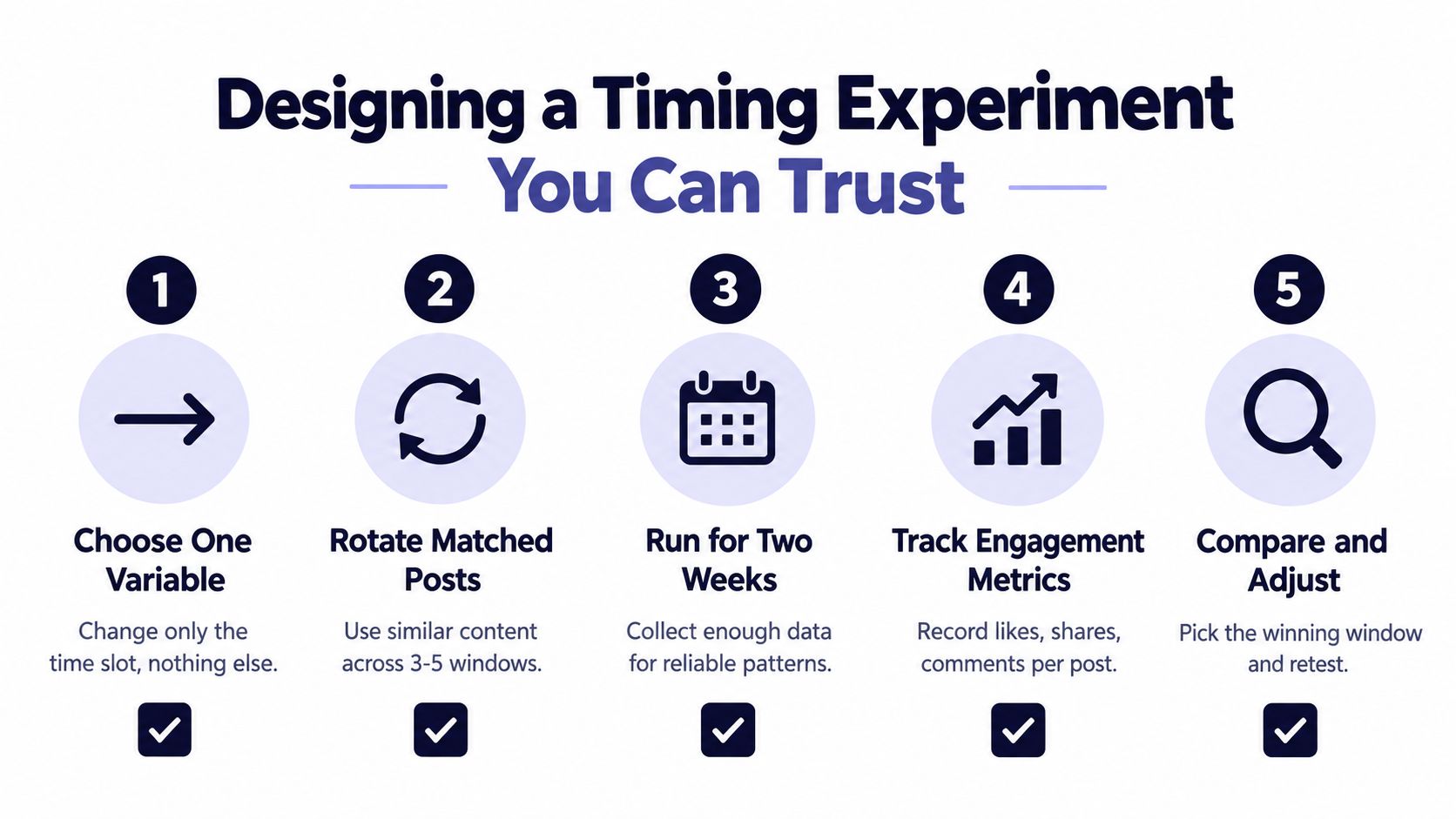
A useful timing experiment changes the time slot while keeping the post and audience as comparable as possible. If the time, format, topic, and distribution all change together, a performance difference won't tell you what caused it.
Set up a fair comparison
Choose one variable. Start with the time window. Don't change the platform, objective, and creative approach at the same time.
Select several windows. Rotate comparable posts across three to five slots, such as morning, late morning, and afternoon. These are test candidates, not universal recommendations.
Match the content. Use posts with similar formats, audience segments, and purposes. If one post is a polished product video and another is a text update, their results can't isolate timing.
Define the outcome in advance. For a discussion post, prioritize comments or shares. For a traffic campaign, examine clicks and conversions. Decide before publishing what would count as a useful result.
Repeat before deciding. A single post can be an outlier. Smaller accounts especially need repeated cycles to distinguish a timing pattern from ordinary variation.
A scheduler's calendar helps make the rotation visible. For instance, a team using the iHatePosting social media scheduling tool can organize scheduled content in a calendar and compare planned slots, rather than relying on memory after posts go live.
Protect the test from confounders
Keep a short record of events that could distort results. Note whether a post was boosted, tied to a trend, or published during a holiday or major news moment. Don't count an unusual viral response as proof that the time slot itself worked.
Use a simple decision rule: keep a window only if it produces a repeatable improvement in the outcome you chose, without weakening the downstream result you care about. If the evidence is mixed, continue testing rather than declaring a winner. Your goal isn't to prove a preferred hour right. It's to learn whether that hour reliably helps your content perform.
Matching Schedule to Audience Geography and Format
A global audience doesn't share one morning. If your followers span regions, a single publishing time may reach one group during a convenient moment and another while they're offline. Treat the schedule as a distribution problem: decide which audience segment matters most for each post, then choose a local-time window that fits that segment.
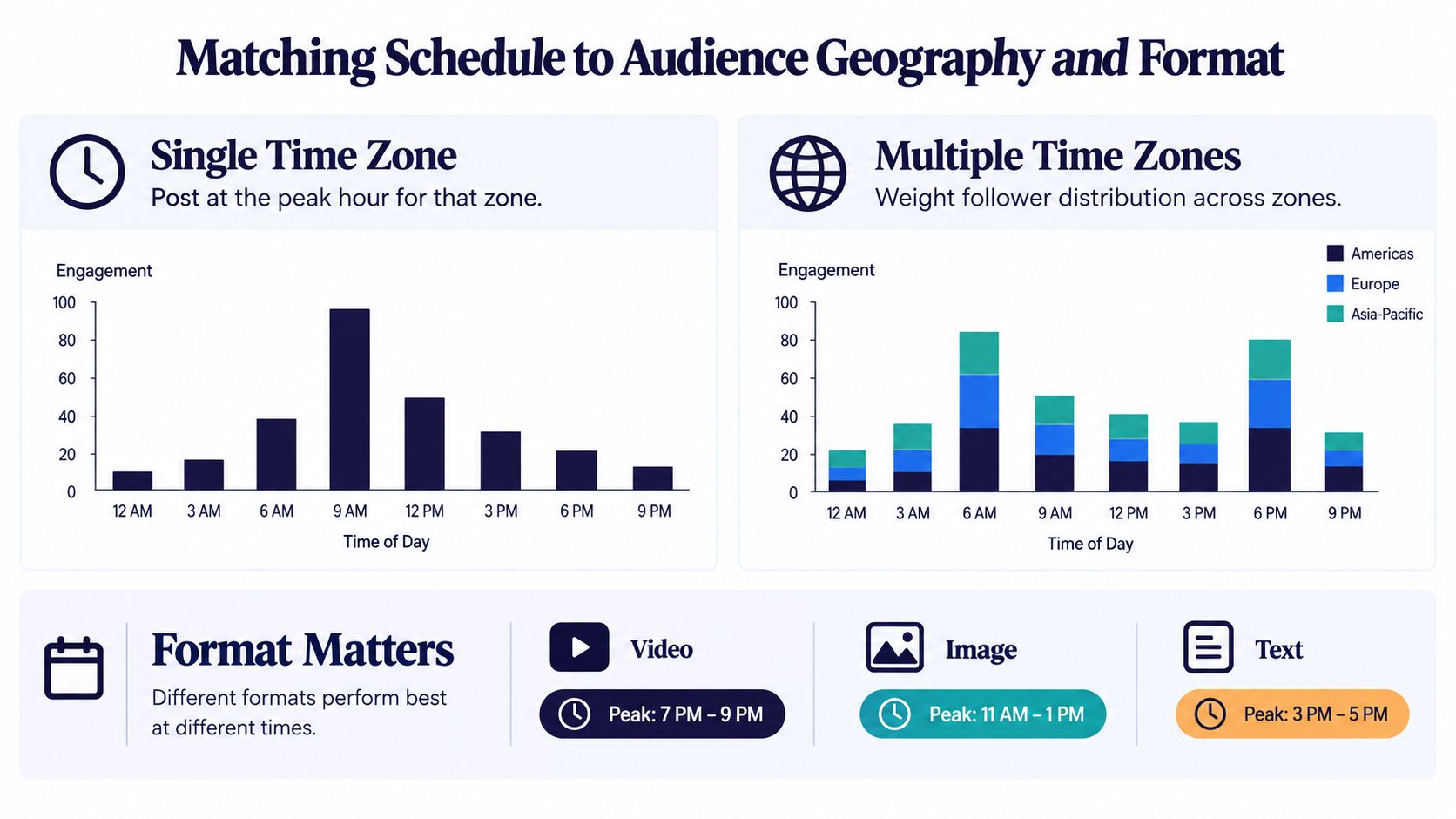
Start by reviewing how your audience is distributed across time zones. Choose a primary segment based on strategic value, not the largest follower count. A smaller audience that regularly clicks through or becomes customers may deserve its own publishing slot.
Then decide whether to use a shared post, staggered regional versions, or a rotation across markets. Staggering can give each segment a local-time opportunity, but repeating identical posts too closely may compete for attention. Compare regional engagement before standardizing the approach. The right choice depends on what your account's own results show, not on an assumption that every region needs separate content.
Build a schedule matrix
Format and objective matter just as much as geography. A quick video may suit a casual browsing moment; an educational carousel may need more attention; a link post may need to reach people when they can act on it. Those are testable hypotheses, not platform-wide laws.
| Format | Primary Objective | Test Windows | Signal to Watch |
|---|---|---|---|
| Short-form video | Views and completion | Audience-active local slots, including after-work windows where relevant | Views and completion behavior |
| Carousel | Saves or discussion | Compare morning and afternoon availability | Saves, comments, and shares |
| Link post | Traffic or leads | Test windows when the target segment can follow through | Clicks and qualified actions |
| Community post | Replies and participation | Test audience-specific active periods | Comments and sustained discussion |
Think of each row as a separate experiment. A brand might test a video for reach and a link post for qualified traffic in different windows, rather than assume the same hour serves both purposes. For Instagram Reels, use platform-specific evidence as a starting point and compare it with your account's results (Instagram Reels timing guidance).
A useful weekly schedule is therefore a matrix, not a single “best time”: audience segment by format by objective. That makes it possible to see whether a time works broadly or only for a particular market and content type.
Organic Reach Versus Paid Amplification Timing
Organic and paid posts shouldn't automatically share a schedule. Paid distribution can change how quickly a post reaches people and how it competes for attention, so a time that works for an organic update may not work as well for a boosted campaign.
A Baylor University analysis of 5,706 Facebook posts from a major U.S. newspaper found that non-boosted posts generated 8.8% more link clicks in the morning than in other tested periods. In the same study, boosted posts received 21% more clicks in the afternoon than boosted morning posts (Baylor University's analysis of Facebook timing). These are benchmarks from one publisher and platform context, not general guarantees.
Keep the delivery modes separate
The finding is a reason to test separate schedules, not to copy those percentages into a forecast. For a campaign, compare organic and boosted performance independently, and judge each by the goal it's meant to achieve. Track click-through rate for both, then examine whether the resulting traffic takes the intended next step.
The study also reported that cognitively demanding content performed better in the afternoon and evening, while morning content drew attention without requiring as much differentiation. That suggests the post's mental workload may matter as well as its distribution mode. A routine update and a detailed explainer don't necessarily belong in the same slot.
If a team needs to respond quickly to campaign activity, timely notifications can help it notice opportunities to recover sales with timely ad alerts. Alerts don't replace a timing test, but they can make it easier to react when a paid campaign needs attention.
Metrics That Confirm Timing Decisions
Don't move a publishing schedule because one post earned quick likes. Confirm the pattern across three measurement layers:
- Early velocity: Check the first 60 to 90 minutes for initial interactions and reach.
- Sustained engagement: Review how comments, shares, and other interactions develop over the following 24 to 72 hours.
- Downstream outcomes: Compare saves, clicks, and qualified actions against the post's objective.
Use these windows to distinguish a fast reaction from a meaningful result. A post may attract early attention without sending qualified visitors to your site, while another may earn fewer quick likes but drive more valuable actions.
Keep a record by platform, format, audience segment, time slot, and delivery mode. Then compare repeated results, not isolated posts. For help organizing what to monitor, review social media analytics for business alongside practical engagement tactics for brands.
A 30-Day Plan to Find Your Best Posting Windows
Use a visual calendar to turn the test into a repeatable routine. A social media calendar can help keep the schedule and results in one view.
- Week one: Log your current schedule and baseline results.
- Week two: Rotate comparable posts across candidate windows.
- Week three: Separate results by audience region and format.
- Week four: Group campaigns, keep the strongest repeatable windows, and add pre-publish checks.
Review results before locking in the next schedule. If a winner isn't clear, keep testing rather than turning a hunch into a rule.
iHatePosting brings planning, per-platform post tailoring, scheduling, and account-based timing recommendations into one workflow across social networks. Use its visual calendar and analytics to organize a timing test and compare results against your account's own history. Visit iHatePosting to see whether its scheduling workflow fits your team.