Best Time to Post YouTube Shorts on Sunday
11 min readbest time to post youtube shorts on sundayYouTube ShortsYouTube posting scheduleShorts engagement tips

Sunday evening, 5–8 p.m. in your audience's local time is the most defensible starting window for YouTube Shorts, with 7 p.m. the strongest Sunday slot in large-scale timing data. Use that as your first test, then compare it with your own YouTube Analytics instead of treating a general average as a permanent rule.
You've finished a Short, written the caption, and opened YouTube Studio on a Sunday. The only decision left seems simple: publish now, or wait until later? If it's morning, waiting is usually the safer choice. If you're preparing for the evening, you're already close to the most useful starting window.
The important distinction is that Sunday can be a good day without every Sunday hour being equally useful. Viewer routines change across the day, and Shorts depend on getting in front of people who are actively scrolling. Broader iHatePosting scheduling tips can help you coordinate that publishing habit across platforms, but YouTube-specific timing still deserves its own test.
This guide breaks the decision into three parts: how Shorts discovery works, what the Sunday data supports, and how to validate those windows against your channel. By the end, you'll have a practical time to schedule this Sunday and a repeatable method for refining it.
Table of Contents
- Introduction Why Sunday Timing Still Matters for Shorts
- How YouTube Shorts Discovery Really Works
- The Best Sunday Windows for YouTube Shorts
- How Sunday Compares to the Rest of the Week
- How to Find Your Personal Best Time on Sunday
- Your Sunday Shorts Game Plan and Next Steps
Introduction Why Sunday Timing Still Matters for Shorts
Your Short is ready on Sunday morning, but your likely viewers may be busy with errands, family plans, or preparation for the week. Publishing immediately can put the video in front of people who have little time to watch. Scheduling it for Sunday evening gives the same idea a better chance to meet viewers during relaxed browsing.
Timing does not repair a weak Short. It can help your first viewers stay long enough to watch, replay, or interact soon after publication. Those early responses give a consistent publishing routine a stronger starting point, especially when your channel is still building momentum.
Two creators can use the same script, editing process, and thumbnail. The first posts as soon as breakfast ends because the upload is complete. The second waits for an evening window when casual viewing is more likely. Neither has guaranteed reach, yet the second has matched publication with a more defensible viewing context.
The practical Sunday starting point
Sunday is better treated as an evening-first discovery window, not a morning routine slot. Buffer's analysis identifies Sunday evening as the clearest area to test, while the broader Shorts pattern also favors later-day viewing. As detailed in the Sunday windows section below, Buffer's analysis places Sunday's top slot at 7 p.m.
Start with 5–8 p.m. local time, then compare those results with your own YouTube Analytics. A general timing study is a map, not a rulebook. Your viewers may behave differently because of their location, age, topic, or weekly routine.
Use iHatePosting scheduling tips to keep publishing habits organized across platforms, but judge YouTube timing through your channel's results. Record the posting time, early retention, views, and engagement so content quality does not get mistaken for a timing effect.
How YouTube Shorts Discovery Really Works
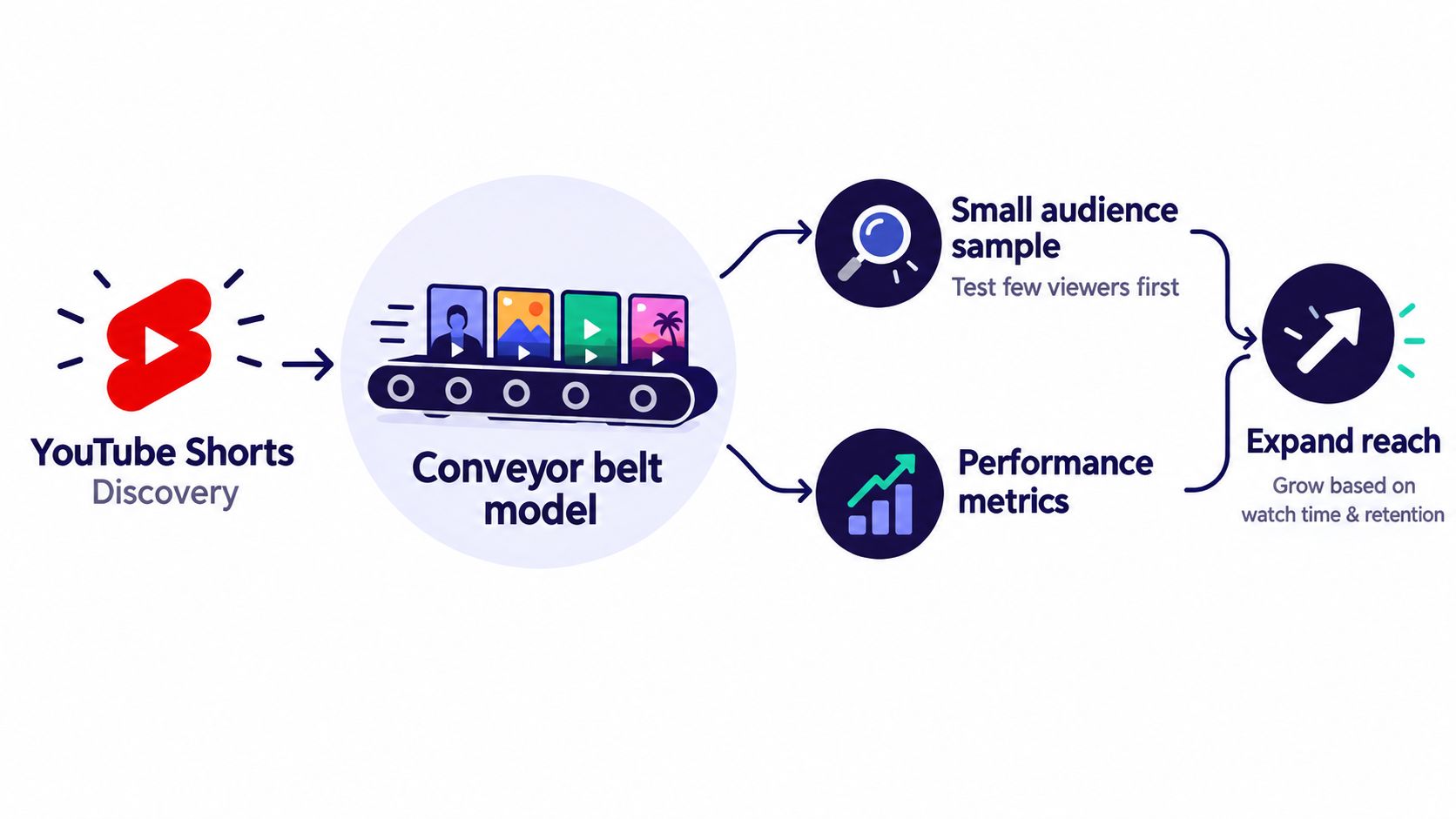
A Shorts upload is less like placing an advertisement on a billboard and more like putting a package onto a conveyor belt. YouTube can show it to an initial group of viewers, observe how they respond, and use those signals when deciding whether to expose it to more people.
The exact outcome depends on the video and its audience, but the useful creator lesson is straightforward. Viewers need to stay with the Short, avoid immediately swiping away, and sometimes replay or engage with it. Publishing while your likely viewers are active gives the video a better chance of receiving meaningful early attention.
Why viewer availability affects timing
Suppose your Short reaches people while they're rushing through errands or preparing for the week. They may swipe quickly, even if the idea would interest them later. The same opening may perform differently when viewers are relaxed and willing to watch through the payoff.
That's why timing isn't a trick for bypassing the algorithm. It's a way to place your content in a more suitable viewing context. A creator promoting a product may also study paid distribution through resources such as FindClout YouTube Shorts advertising, but organic timing still begins with understanding when people are likely to browse.
Sunday has a distinct rhythm. Morning viewing can compete with household plans, travel, chores, and preparation for the week. Later in the day, viewers often have more room for casual scrolling, which is why evening testing makes more sense for many channels.
What you can control
Timing only solves the availability problem. Your Short still needs a clear opening, a focused idea, readable visuals, and an ending that rewards the viewer for staying.
Before publishing, check the basic packaging. A concise title can support discovery outside the immediate feed, and an iHatePosting YouTube title checker can help you review wording before you schedule.
Timing is about matching viewer availability, not tricking the algorithm.
The Best Sunday Windows for YouTube Shorts
Sunday works best as an evening-first discovery window for many channels. Use the ranked times below as starting points, then compare them with your own audience data instead of treating a general report like a fixed rule.
Sunday evening posting windows ranked
| Time Slot | Relative Strength | When to Use It |
|---|---|---|
| 7 p.m. | Strongest Sunday starting point | Use it as your first default test |
| 8 p.m. | Very strong alternative | Compare it with 7 p.m. for entertainment, commentary, and wind-down content |
| 5 p.m. | Strong early-evening option | Test it when your audience starts browsing before the later evening |
This ranking comes from Buffer's cross-account analysis of 1.8 million videos (Buffer's analysis). It gives you an order for testing: begin with 7 p.m., compare 8 p.m., then examine whether 5 p.m. catches viewers earlier.
The practical reason is simple. Sunday mornings often compete with errands, household routines, and preparation for the week. By evening, viewers may have more uninterrupted time to browse. A comedy clip, reaction, opinion, or lifestyle Short can fit that relaxed session more naturally than a breakfast-time upload.
When midday deserves a test
Midday should remain a secondary experiment when the subject matches a daytime routine. One 2026 timing study reports strong Shorts periods around 12–3 p.m. and 7–10 p.m., while another guide identifies Sunday evening as a high-engagement period and describes Sunday morning as weaker (RecurPost's YouTube timing guide).
Meal preparation, fitness routines, weekly planning, and similar topics may benefit from a lunchtime release. The content gives viewers a reason to watch while they are already planning or acting.
For a general starting plan, test 5–8 p.m., with 7 p.m. at the center. Then open YouTube Analytics and compare impressions, viewed percentage, and early engagement across Sunday uploads. Generic timing is a map, not your channel's destination. If your viewers are active earlier, let that pattern replace the default.
How Sunday Compares to the Rest of the Week
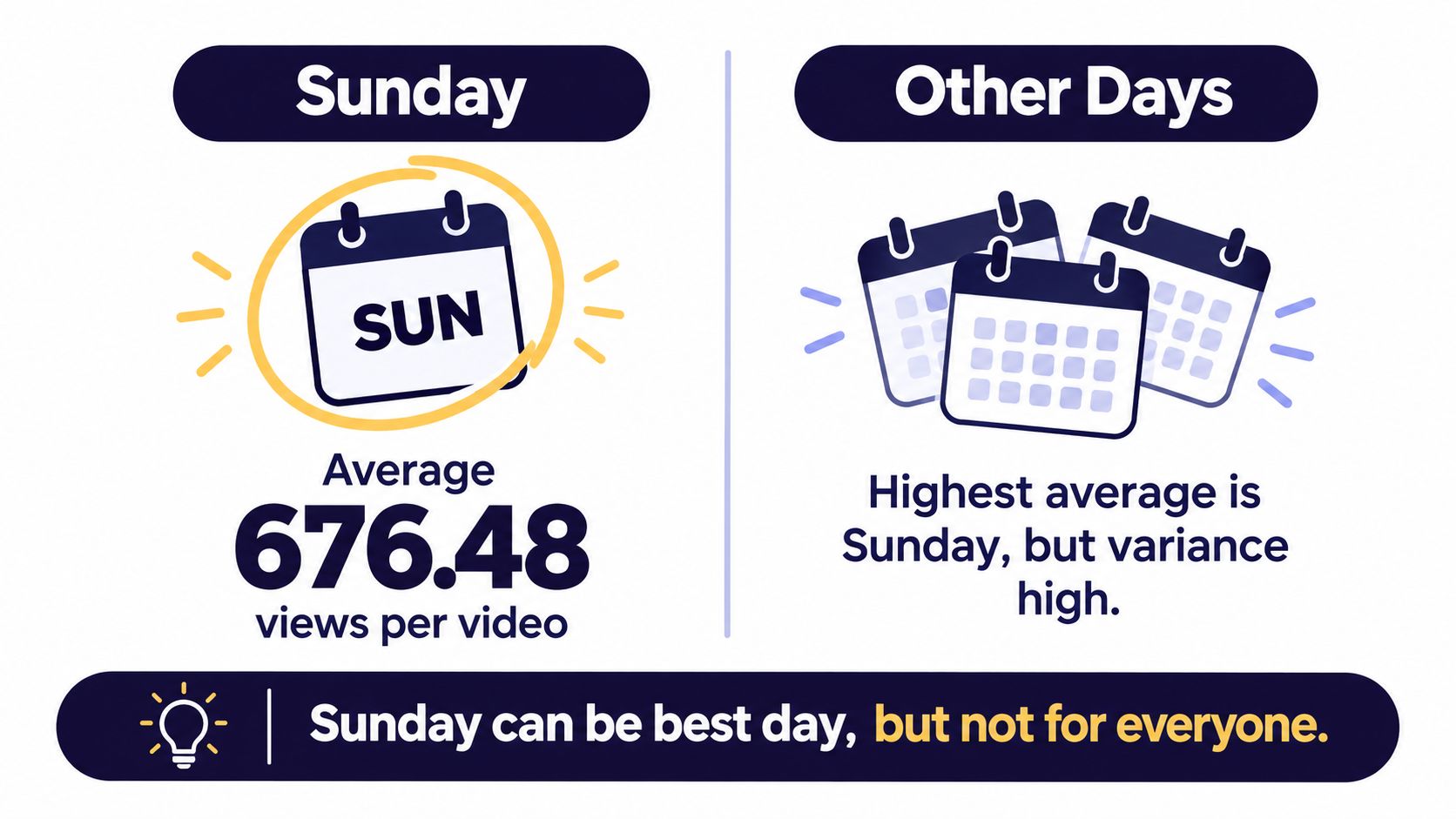
Sunday data can look contradictory until you check what each dataset measures. One independent 2026 summary reports that Sunday Shorts received an average of 676.48 views per video in Metricool's dataset and describes Sunday as the best day to upload YouTube Shorts (Blogging Wizard's Shorts statistics summary).
That result makes Sunday worth testing. It doesn't mean every channel should abandon Friday, Saturday, or weekday experiments. Buffer's much larger cross-account analysis ranks Friday's 4 p.m., 6 p.m., and 7 p.m. slots above the Sunday entries, so Sunday is viable without being automatically dominant across every audience.
How to read different timing studies
Use three questions when two reports appear to disagree:
- What was measured? An average view count answers a different question from a ranked posting-time analysis.
- How broad was the sample? A cross-account dataset can provide broad guidance, while a platform summary may describe a particular underlying dataset.
- How was time handled? Local-time reporting is more useful for scheduling than a single clock that ignores audience geography.
The answer also depends on your goal. If you want a dependable weekly publishing slot, Sunday evening is a reasonable anchor. If you're searching for the strongest day overall, compare Sunday with Friday rather than assuming the weekend is uniform.
A balanced decision
Treat Sunday as a primary test day when your audience watches casually on weekends, your topics suit relaxation, or your channel already sees Sunday activity. Treat it as a secondary experiment when your content is tied to weekday work, school, or business routines.
You can also use a broader cross-platform planning workflow, then find your best Instagram Reel time separately. Each platform can develop its own audience rhythm, so copying one network's schedule to another creates unnecessary confusion.
How to Find Your Personal Best Time on Sunday
General data gives you a starting line. Your own channel data decides whether that starting line is right for your viewers.
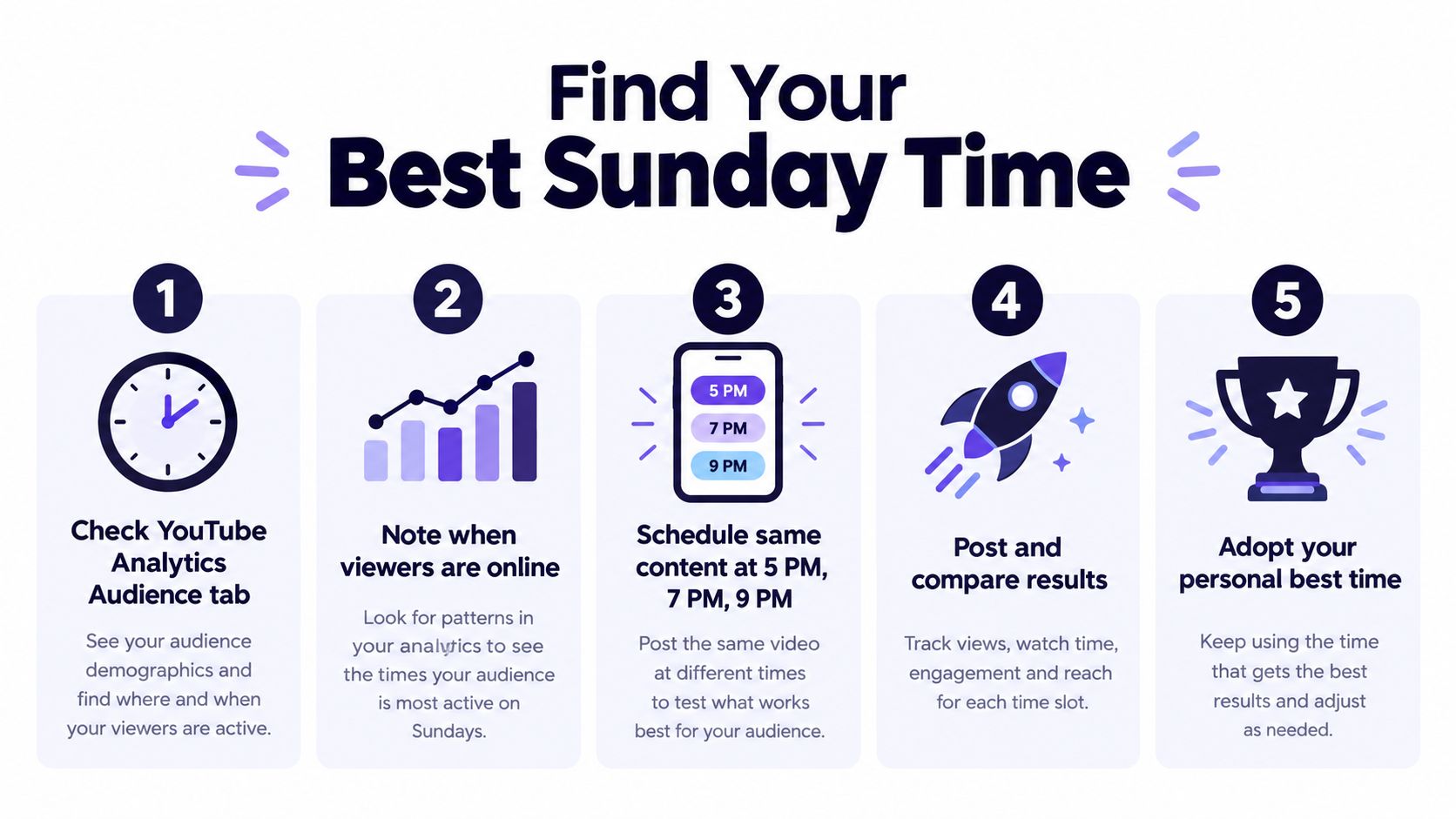
Open YouTube Studio and look at the Audience area, particularly the report showing when your viewers are on YouTube. Use the Sunday activity pattern as a guide, but don't treat a dark activity period as proof that every Short should be published at its exact beginning. Test a small group of nearby evening slots and compare the results consistently.
A simple three-Sunday test
Use the same type of Short across three Sundays. Schedule one at 5 p.m., another at 7 p.m., and the third at 8 p.m. Keep the subject, format, approximate length, hook style, and production standard as similar as possible. You're testing the clock, not asking a completely different video to produce the answer.
Track the early indicators that help you understand initial distribution:
- Views during the first two hours, which shows how quickly the Short attracts initial attention.
- Average view duration, which helps you see whether viewers stay with the content.
- Completion and replay behavior, where available in your analytics, because a Short that holds attention can remain useful beyond its initial release.
Record each result in a simple spreadsheet. Include the Sunday date, local posting time, topic, format, first-two-hour views, average view duration, and any notable audience response.
Keep the experiment fair
Use your channel's primary time zone, especially if you schedule from a different region than your audience. If your audience is spread across countries, look at top geographies before deciding which local clock matters most. A single posting time can't perfectly match every viewer, so prioritize the region that contributes the most meaningful activity.
Don't change the title style, thumbnail frame, opening, and topic all at once. A stronger hook can overwhelm a timing difference, leaving you unable to tell which variable caused the result. You're not trying to create a laboratory experiment. You're making the comparison clean enough to support a decision.
For creators managing several platforms, iHatePosting's social media scheduler template resources can help organize publishing dates and test notes. The important part is the habit: schedule deliberately, log what happened, and update your Sunday choice from your own evidence.
Your Sunday Shorts Game Plan and Next Steps
For the next Sunday, make the decision simple. If you don't yet have enough channel-specific evidence, schedule your Short for 7 p.m. local time. If you're running a comparison, choose one of the surrounding evening slots and keep the content format consistent.
Your preparation checklist should fit into a short working session:
- Finish the opening: Make the first moment clear enough to earn continued attention.
- Review the title: Remove vague wording and make the subject easy to understand.
- Check the audience clock: Confirm that the scheduled time matches the location you're trying to reach.
- Prepare the upload: Add the final description, relevant details, and any platform-specific text.
- Log the result: Review early views and watch behavior after publication, then record the result on Monday.

The main principle is evening first, personal data second. Start with the Sunday pattern supported by the available research, then let your audience show you whether 5 p.m., 7 p.m., 8 p.m., or a different tested window fits better.
Consistency makes the test useful. A single Sunday can be noisy, while a repeatable cadence gives you a clearer basis for deciding whether Sunday should become a core publishing day or remain one part of a wider weekly schedule. If manual uploads keep interrupting your workflow, you can automate YouTube Shorts posting and preserve the same deliberate timing.
iHatePosting brings YouTube scheduling, a visual content calendar, per-platform caption tools, and account-based timing recommendations into one workflow. Visit iHatePosting to plan your Sunday Shorts, test publishing windows, and keep the results organized without switching between multiple scheduling tools.