Social Media and Content Marketing: A 2026 Playbook
19 min readcontent marketingsocial media strategycross-platform publishingcontent distribution

Social platforms now account for 5.66 billion active user identities worldwide, equivalent to 68.7% of the global population, according to DataReportal's October 2025 analysis. That scale changes how to think about social media and content marketing: creating something useful is only part of the job. You also need a deliberate way to put it in front of people who could benefit from it.
Table of Contents
- Why Social Media Became the Main Stage for Content
- Where Content Marketing Ends and Social Media Begins
- Planning Pillars and Calendars Before You Post
- Adapting One Idea to Each Platform's Rules
- Turning One Idea into a Week of Posts
- Building a Posting Rhythm That Holds Up
- Using AI Drafts Without Sounding Automated
- Measuring Whether Social Posts Move the Business
- Start With a One-Channel Test This Month
Why Social Media Became the Main Stage for Content
Those user identities aren't an exact count of individual people. Someone with accounts on several platforms can appear more than once, so the figure signals the size of the distribution environment rather than a precise human headcount.
For a small business, the useful question isn't how to reach everyone. It's how to help the right people discover an idea they wouldn't otherwise encounter.
Say a bakery publishes a detailed recipe on its website. Existing customers appreciate it, but few new visitors arrive. In a hypothetical campaign, the baker turns the same recipe into a 30-second video showing the moment the dough reaches the right texture. During the following week, viewers start messaging questions about ingredients and classes.
Discovery needs something worth discovering
The website recipe and the video do different jobs. The recipe gives someone enough detail to bake successfully. The video makes the lesson visible and gives viewers a reason to care.
Neither guarantees a sale. The baker still needs a clear profile, an understandable offer, and someone available to answer questions.
- Discovery: Show a useful detail that someone can understand without already knowing the business.
- Conversation: Answer the questions that appear beneath the post.
- Next step: Give interested viewers somewhere relevant to go, such as the full recipe or a class booking page.
Social platforms are places where people encounter, discuss, and judge content, not noticeboards for website links. A creator, agency, or marketing team therefore needs coordinated publishing across suitable networks rather than an abandoned profile on every available platform.
Broad distribution works best when each channel has a specific job. That begins with understanding what content marketing supplies and what social media adds.
Where Content Marketing Ends and Social Media Begins
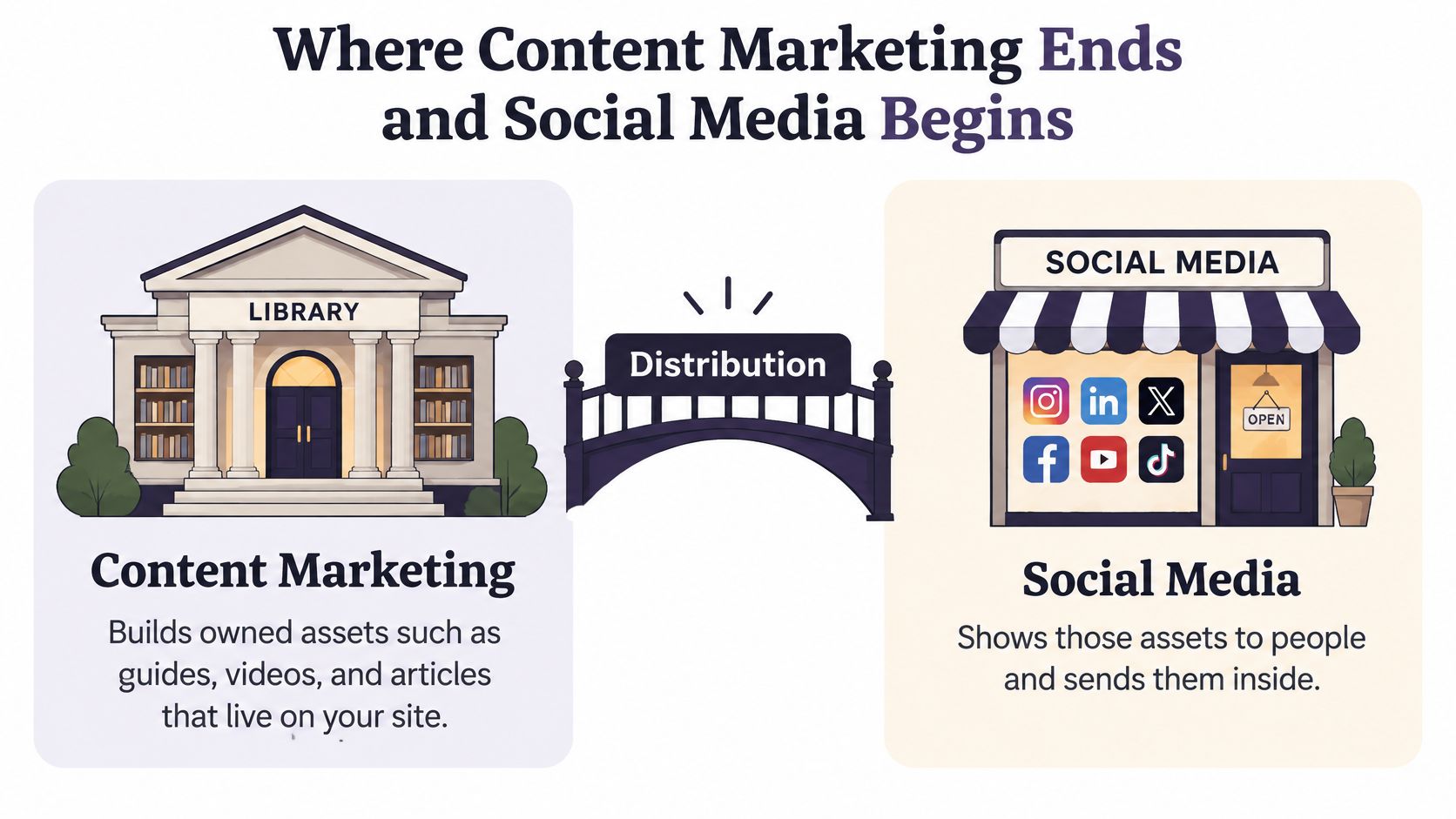
Content marketing builds the library. Social media supplies the shop window that invites people inside.
The library contains substantive resources: guides, articles, newsletters, webinars, and videos that help an audience understand a problem. The window presents an inviting selection, starts a conversation, and gives people a reason to explore further.
The distinction is useful, but it isn't absolute. A thoughtful LinkedIn post can teach a complete lesson, and a YouTube video can be both a durable resource and a discovery tool. Think of content marketing as the value you develop and social media as a distribution and conversation layer, rather than treating every format as belonging permanently to one category.
What content marketing and social media each do
| Aspect | Content marketing | Social media |
|---|---|---|
| Core purpose | Build trust and demand over time | Start conversations and spread ideas quickly |
| Typical output | Guides, videos, newsletters, webinars | Posts, short videos, threads, stories, replies |
| Time horizon | Months, as archives and search keep working | Hours to days, though some posts resurface |
| Who controls the asset | You own it on your site or list | The platform controls reach and distribution |
| Main success signal | Leads, subscribers, branded demand | Reach, saves, shares, qualified profile visits |
The relationship is easier to picture as a connection between a substantial resource and its public-facing presentation.
Useful posts don't always need a click
A social post should offer something worthwhile on its own. If every caption merely announces a new article, people have little reason to follow the account.
Give the reader an answer, demonstration, or practical distinction first. Then offer the deeper resource when it would help. A bookkeeper might explain how to organize receipts in the post and direct readers to a downloadable filing checklist for the full process.
The business purpose remains important. In the Content Marketing Institute's 2025 B2B benchmark research, 87% of surveyed marketers said content marketing created brand awareness during the previous year, while 74% said it generated demand or leads. Those are different outcomes, and your content plan should distinguish between them.
Control is part of the strategy
A social profile is rented space. Platform operators can change distribution rules, features, or account access, while your website archive and permission-based email list give you more direct control over how you organize and reach an audience.
That doesn't make social media a bad investment. It means you shouldn't ask a feed to perform every marketing function.
Create the substantial asset once, then design each social version intentionally. Keep the useful explanation accessible outside the feed, and make the transition between post, resource, and offer easy to understand.
Working model: Content marketing develops useful ideas; social media distributes them, tests their relevance, and opens conversations around them.
Planning Pillars and Calendars Before You Post
Start with a business question, not a platform. A bookkeeper whose clients repeatedly miss filing deadlines has a clearer starting point than a bookkeeper who just wants to post more often.
A content pillar is a recurring subject you can explore from several useful angles. For this bookkeeper, deadline preparation could include organizing documents, setting reminders, and understanding when to seek professional advice.
Choose a manageable set of pillars, such as three to five, rather than giving every new idea its own category. This is an organizing recommendation, not a required publishing formula.
Complete a short brief
Before drafting, record these fields. Our planning process asks these seven questions before publishing:
- Content pillar: Which recurring audience problem does this address?
- Audience intent: What does the reader want to accomplish or avoid?
- Platform fit: Where will this idea make sense to the intended audience?
- Creative alignment: Which visual or presentation makes the explanation clearer?
- Hashtag strategy: Which relevant topic labels, if any, help describe it?
- Measurement method: What observable action would suggest the post helped?
- Campaign context: Which offer, launch, or seasonal need does it support?
For a hypothetical quarterly-deadline campaign, the bookkeeper could choose an intent of avoiding missed obligations, LinkedIn and YouTube as suitable channels, and a checklist graphic as the creative. She might select two niche hashtags, measure calendar-download clicks, and place the campaign within the Q3 filing window without implying that every reader has the same legal deadlines.
Make responsibilities visible
Put the brief into a calendar showing the week, channel, owner, draft status, content pillar, and planned publication time. Separate drafting, review, approval, and scheduled status so an unfinished post doesn't look ready merely because it has a date.
Use the reusable monthly planning tips from iHatePosting to establish a repeatable layout. Keep the calendar simple enough that someone can spot an empty week, a missing approval, or an overloaded reviewer without opening every draft.
Adapting One Idea to Each Platform's Rules
A joke that lands in one room can fall flat in another, even with identical wording. Social networks behave the same way. Each one sets its own caption limits, media formats, and audience expectations, and a caption that technically fits may still read awkwardly in that feed.
The caption and media figures below come from Circleboom's platform publishing guide. Composers and connected-account rules change over time, so confirm the current limits before scheduling.
Platform limits that change the caption and media
| Platform | Caption limit | Media and hashtag rules |
|---|---|---|
| X | 280 characters for standard posts | Short text; the opening line carries most of the weight |
| 2,200 characters | Up to 30 hashtags; carousels up to 10 items | |
| TikTok | 4,000 characters | Vertical video |
| YouTube Shorts | 5,000 characters in descriptions | Vertical video |
Networks not listed here set their own ceilings, so run the same check on every channel you plan to use.
Treat these figures as ceilings on length and volume. A hashtag allowance works like a luggage limit: the airline permits a full suitcase, yet nobody recommends packing to the weight ceiling. The same logic applies to caption space. The room exists for posts that genuinely need it.
Adapt the message without changing its meaning
Adaptation works like translation. The meaning survives while the delivery gets rebuilt. Begin with the chosen idea and the planning answers behind it, then work through this sequence:
- Pick the core claim. State the useful point in one plain sentence. For the bookkeeper, it might be that collecting documents continuously makes deadline preparation easier.
- Rewrite the hook for the room. A professional audience may respond to the administrative cost of missing paperwork. A visual audience may respond to watching a scattered pile of documents become a tidy folder.
- Adjust the length. Cut background the viewer doesn't need, but keep qualifications that prevent the advice from becoming misleading.
- Choose media that suit the explanation. Use a demonstration when movement matters and a carousel when someone needs to move through a sequence at their own pace.
- Set hashtags deliberately. Pick relevant labels rather than attaching the same saved block to every topic.
- Tag the post for measurement. Record campaign, channel, format, and creative version so you can identify what performed later.
Before release, confirm the adapted version still answers the same planning questions the original did. A clever opening shouldn't turn a practical checklist into an exaggerated promise.
Use formats for their strengths
A carousel earns its place when each panel advances the explanation. Put the problem on the opening panel, use the middle panels for useful distinctions, and reserve the ending for a relevant next step.
For a practical production example, Visual Sandbox explains how to turn ideas into carousels with Claude. Review generated text, slide order, and visual consistency before treating the result as publishable.
It also helps to understand cross posting across social platforms: distributing one underlying idea doesn't require identical wording everywhere.
When you test, change one deliberate variable at a time within a platform, such as the opening line. Comparing entirely different posts across different networks won't isolate the cause, because the audiences and distribution conditions changed too.
Turning One Idea into a Week of Posts
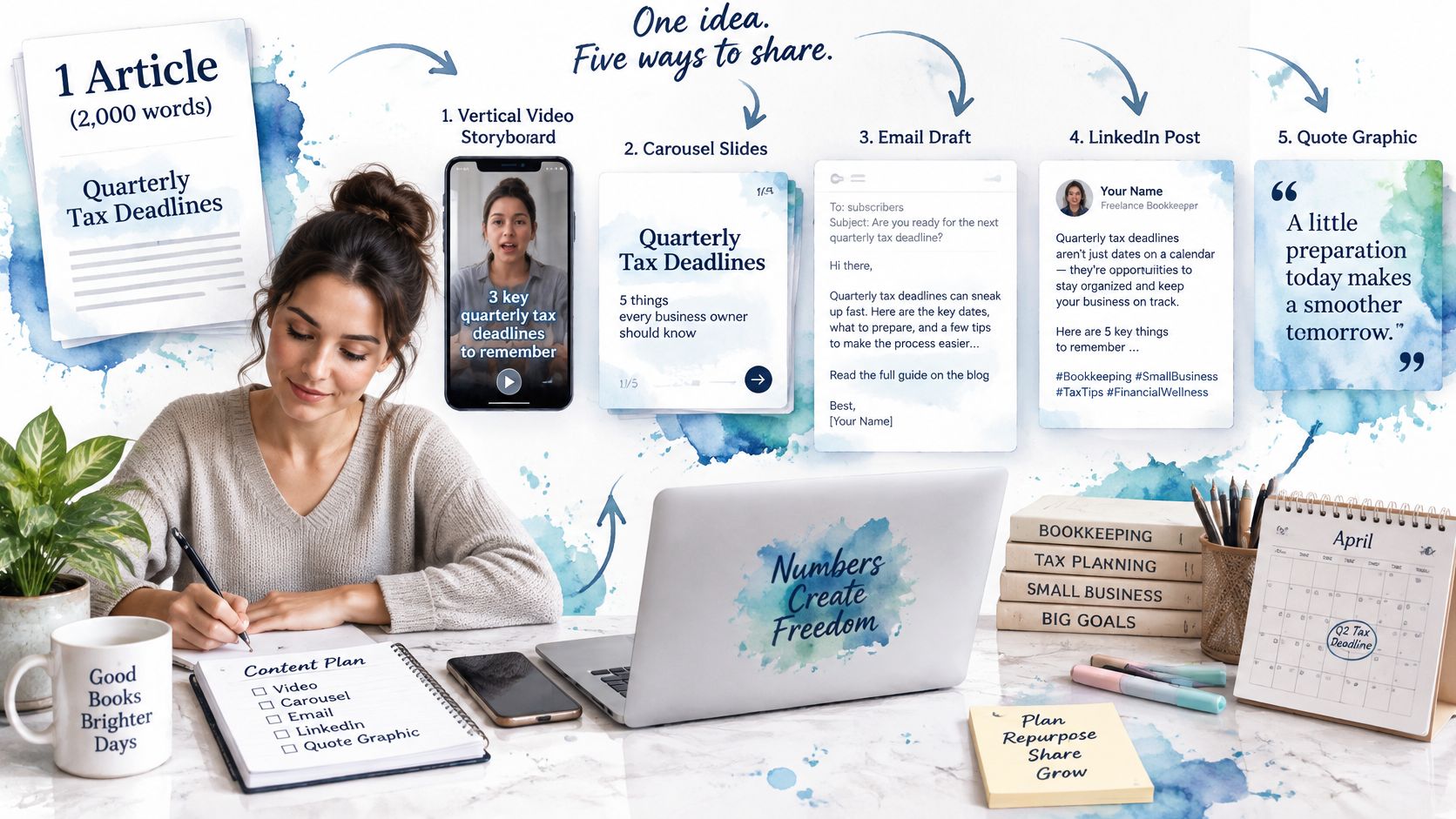
Say a freelance bookkeeper writes a 2,000-word article about preparing for quarterly tax deadlines. This is a hypothetical content package, not a claim about the ideal article length. Her article explains document collection, reminder systems, and the questions readers should take to their own tax adviser.
She plans the derivatives together so each one contributes something distinct.
Give each version a different viewing experience
The 45-second vertical video opens with a recognizable problem: paperwork scattered between an inbox, a drawer, and a phone. Viewers see the bookkeeper gather those documents into a simple system. The purpose is discovery, not a compressed reading of the full article.
Her seven-slide Instagram carousel becomes a saveable preparation checklist. Each slide handles a distinct task, with a clear reminder that obligations differ by location and business circumstances.
On LinkedIn, she writes a text post about the hidden administrative work behind deadline stress. She ends with a question about where readers lose track of documents, inviting relevant experiences rather than empty agreement.
An X thread of five posts follows the preparation sequence. Each post makes sense as a short instruction, while the thread provides a useful path through the topic.
The longer YouTube explainer shows the workflow on screen. Its description links to the article so viewers can revisit the written checklist without replaying the entire demonstration.
For additional ways to choose useful derivatives, TheContentMap explains how to repurpose content into multiple formats. The important editorial decision is what each version helps someone do, not how many files you can produce.
Treat video as a test, not a verdict
A 2024 Statista survey, cited in industry benchmark reporting on social content performance, associated short-form video with the highest marketer-reported ROI among social formats. That's a perception-based benchmark, not proof that short video will outperform every alternative for this bookkeeper.
She should compare viewer retention, relevant questions, resource visits, and eventual inquiries before expanding production.
A video resource can sit alongside the written workflow:
Her illustrative publishing week spreads the formats out:
| Day | Planned asset |
|---|---|
| Monday | Vertical discovery video |
| Tuesday | Instagram checklist carousel |
| Wednesday | LinkedIn discussion post |
| Thursday | X thread |
| Friday | YouTube explainer |
High reach with weak retention can signal a packaging problem. Strong retention with weak conversion can point to an audience mismatch or an ineffective call to action. Treat both as diagnostic clues, not automatic conclusions.
Building a Posting Rhythm That Holds Up
Consistency is a practical problem, not a test of motivation. In Buffer's six-month analysis across multiple networks, inconsistent users posted during four or fewer of 26 weeks, consistent users during 5–19 weeks, and highly consistent users during at least 20 weeks; the highly consistent group received approximately five times more likes, comments, and shares per post than the inconsistent group.
The finding is observational. It doesn't establish that scheduling alone caused the difference, and it doesn't mean a busy calendar guarantees engaged readers.
What you can control is whether publishing requires an exhausting chain of last-minute decisions. If someone must find an image, rewrite a caption, locate a password, and request approval every time, missed posts are unsurprising.
Batch the decisions that belong together
Use this as a starting routine, reducing the volume if your review capacity is limited:
- Draft and adapt in batches. Prepare a month's planned posts in one or two focused sessions, leaving room for timely responses and corrections.
- Inspect the calendar. Look for repeated topics, unfinished assets, and drafts that still need subject-matter review.
- Schedule reusable material. Place evergreen explanations and recurring reminders where they remain relevant, checking links and time-sensitive wording before reuse.
- Reserve review appointments. Set fixed times for comments and analytics instead of checking every notification as it arrives.
Users bring their ideas, captions, images, videos, campaigns, and chosen platforms into the workflow, then build a rhythm they can maintain. A social media scheduler should support that routine rather than become another place where unfinished work accumulates.
Protect the time outside the feed
Our digital wellness guidance includes batching posts, removing nonessential notifications, keeping a reliable online home that a feed doesn't control, and scheduling review times. Judge your working process by clarity and consistency, not whether today's post beat yesterday's.
That doesn't mean ignoring customers. Give someone responsibility for checking urgent messages, and distinguish customer-service needs from routine performance monitoring.
An illustrative weekly rhythm could contain three anchor posts and two recycled posts. Anchor posts introduce the current lesson or offer; recycled posts reuse still-useful evergreen assets already recorded in the planning calendar.
| Type of post | Review before scheduling |
|---|---|
| New anchor content | Claim accuracy, creative fit, approval |
| Recycled evergreen content | Continued relevance, working destination, outdated wording |
| Timely response | Context, tone, appropriate owner |
Don't increase the cadence until the existing routine is sustainable. A smaller schedule with finished assets and accountable reviewers is more useful than a crowded calendar that repeatedly slips.
Using AI Drafts Without Sounding Automated
Adding an AI label and moving on doesn't settle the question of authenticity. Readers can understand that AI helped produce a post and still doubt its accuracy, effort, or sincerity.
In a 2026 study of 339 U.S. participants, people who noticed an AI disclosure evaluated the advertisement, brand, and likelihood of engagement less favorably. That finding isn't a reason to conceal AI use. It's a reason to pair transparency with content that deserves attention.
AI-powered content generation can prepare platform-specific captions, hooks, hashtags, images, and short videos, helping you move past a blank page and reduce manual production work. AI agents can carry approved tasks through creation, adaptation, scheduling, and publishing across networks, reducing repeated handoffs between separate tools.
Match disclosure to what AI actually did
Treat the following as an editorial framework, not a substitute for applicable laws or platform policies:
- AI-assisted copy: Keep a human responsible for the argument, wording, and claims. Explain the assistance when it materially affects how readers should interpret the content.
- Generated images: Label imagery that readers could mistake for a real product photograph, customer result, or documented event.
- Synthetic people or voices: Use prominent disclosure when a realistic person or voice wasn't recorded as presented. Don't imply a genuine customer endorsement.
- Automated engagement: Avoid replies that pretend a human personally read and considered a message when no one did.
- Agentic publishing: Define what an agent may publish independently and what must stop for approval.
A provenance log is a record of what was generated, which source material informed it, who edited it, and who approved the final version. Keep it with the draft rather than relying on someone to remember the production history.
Make human review substantive
Check claims against their original sources. Remove fabricated anecdotes, inspect cultural references, and read customer-facing replies in the context of the actual conversation.
For practical task boundaries, JoinBrands offers examples of AI workflows for busy marketing teams. Use those ideas alongside a written decision about what to automate on social media, especially where an error could mislead a customer.
In our workflow, drafts, previews, and approvals stay together so review can happen before release. The approval should confirm more than spelling: a named person should accept responsibility for what the post says.
Try a controlled comparison: Compare fully generated drafts with human-directed, AI-adapted posts using a similar topic and format. Apply the same disclosure standard to both, then assess accuracy, relevant responses, and business outcomes, not merely which version was quicker to produce.
Measuring Whether Social Posts Move the Business
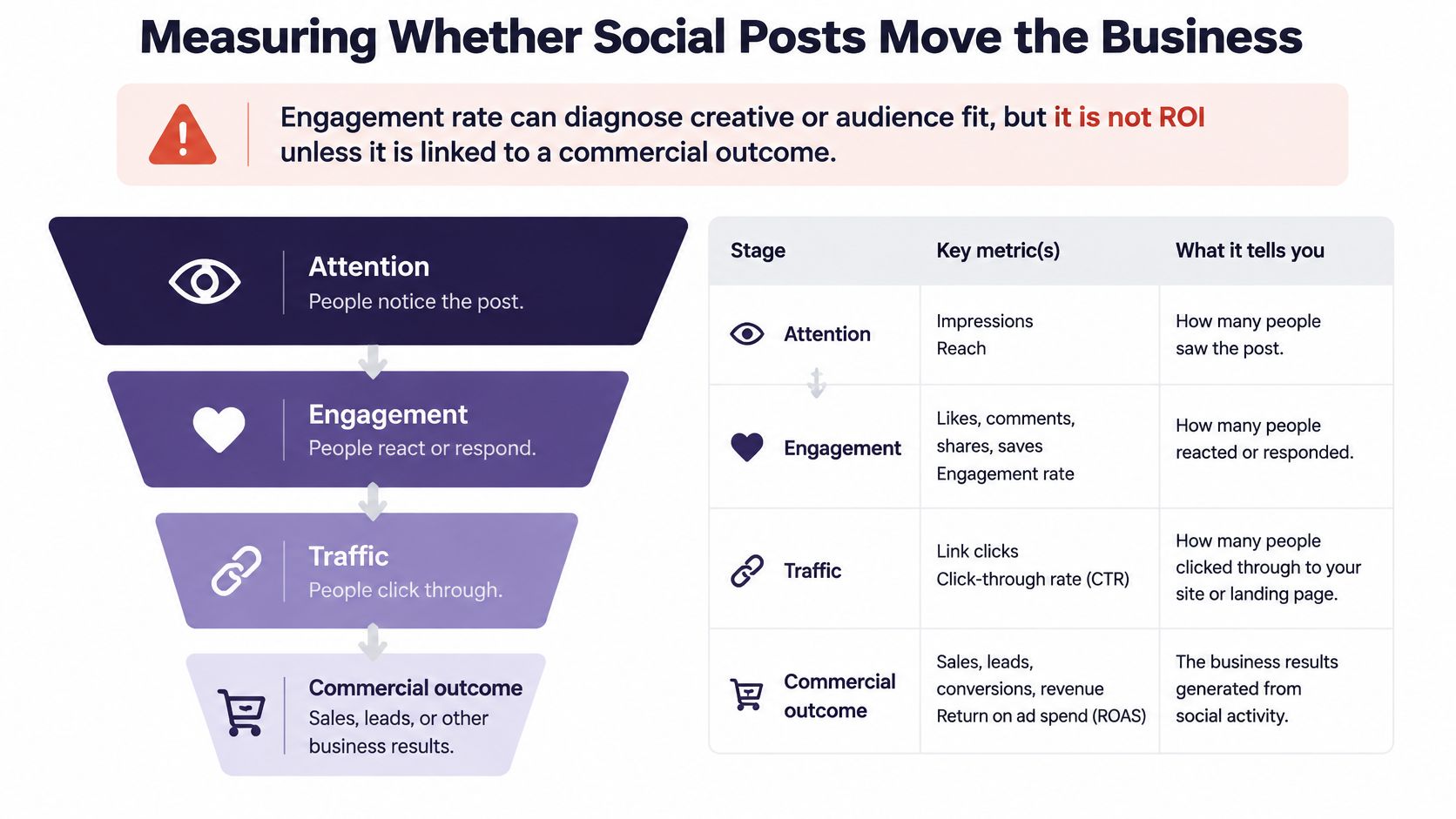
Engagement rate isn't ROI. It can help diagnose whether a message resonates, but return on investment requires a connection between what you spent and a commercial outcome.
A global Semrush study summarized by Elite Content Marketer found that 70% of very successful companies measured content ROI, compared with 46% of minimally successful companies. That association doesn't prove measurement causes success, but it supports making evaluation part of the operating process rather than an afterthought.
Social metrics from attention to outcome
| Metric tier | Example metrics | What it tells you | Common trap |
|---|---|---|---|
| Attention | Impressions, reach, video retention | Whether the packaging gets seen and watched | Mistaking reach for demand |
| Engagement | Saves, shares, replies, comments | Whether the idea resonates with people | Treating engagement rate as ROI |
| Intent | Qualified profile visits, branded search, direct traffic | Whether interest moves toward you | Hard to attribute cleanly |
| Outcome | Leads, sales, subscribers, retention | Whether content affects revenue | Needs a time window and enough sample |
The progression helps separate an encouraging reaction from a business result.
Evaluate a portfolio of influence
Someone can watch a helpful post, remember the business, and search for it later without clicking the original content. Last-click reporting, which credits the final recorded interaction before conversion, won't necessarily capture that contribution.
Treat social content as a portfolio with different roles. Some posts introduce the problem, some demonstrate competence, and others help a ready buyer act.
Combine platform-native attention metrics with saves, shares, and replies. Then examine branded-search activity, direct traffic, and assisted conversions, meaning interactions that preceded a later conversion elsewhere.
For stronger evidence, compare similar customer cohorts or geographic areas exposed to different campaign conditions. Also categorize comments and sales conversations by theme, such as pricing questions, repeated objections, or explicit mentions of a post. None of these methods provides perfect attribution, but together they offer a more credible picture than a single engagement score.
Write the scorecard before release
Record the following before publication:
- Primary business KPI: Choose the key performance indicator that matters to the campaign, such as qualified consultation requests.
- Supporting distribution KPI: Select a diagnostic measure, such as retention or relevant profile visits.
- Attribution window: Define how long you'll observe responses and later conversions.
- Minimum sample: Decide what volume of evidence is sufficient before changing direction.
Tag every post with channel, format, campaign, and publication time. Identical copy across networks doesn't make the comparison fair, because different audiences and recommendation systems still affect exposure.
Use that record to track social KPIs that matter. If evidence remains thin, report uncertainty rather than declaring a winning platform from a handful of reactions.
Start With a One-Channel Test This Month
- Choose a business question. Select a content pillar tied to something customers need to understand.
- Create a substantial asset. Write a guide, record an explanation, or build a resource that answers the question properly.
- Prepare three channel-ready versions. Publish on one primary channel first; keep the other adaptations ready for expansion rather than launching everywhere immediately.
- Schedule four weeks of posts. Use a calendar that exposes unfinished drafts, missing creative, and gaps in coverage.
- Set a fixed review point. Reserve time for comments and analytics so the test doesn't depend on constant checking.
- Keep, change, or drop the approach. Use the scorecard written before publishing, and extend the test if the evidence isn't sufficient.
Give the test a clear boundary
Treat this as a 30-day practice cycle, not a promise of results within a month. Hold the audience problem and primary channel steady long enough to learn something, then decide whether the next cycle needs a different hook, resource, or offer.
Beginners need a structured place to practise more than a long list of tools. Our approach gives new users a place to plan and remain consistent across channels, while keeping the original content and its adaptations organized.
Our supported scheduling networks are Instagram, LinkedIn, X, Facebook, TikTok, YouTube, Pinterest, Bluesky, Threads, Mastodon, Telegram, Discord, Tumblr, and Slack. Choose based on where your audience participates, not the length of that list.
A calendar can organize the test, but iHatePosting can't guarantee Instagram views, reach, followers, or sales. It can help you publish more consistently and keep creative work organized while you judge whether the content serves the business.
iHatePosting brings content planning, platform-specific adaptations, scheduling, and human review into one workspace. Visit iHatePosting to organize your first content pillar, prepare its social versions, and build a publishing calendar you can realistically maintain.