Metricool vs Hootsuite: 2026 Comparison and Verdict
15 min readMetricool vs Hootsuitesocial media toolsscheduling softwareHootsuite pricing
The most popular advice in a Metricool vs Hootsuite comparison is to count features and pick the platform with the longer checklist. That approach misses the decision that causes the most buyer regret: how the software bill changes when your team, client roster, or account portfolio grows.
Both platforms can schedule social content and report on performance, but they're built around different operating assumptions. Hootsuite leans toward centralized control, governance, and enterprise workflows. Metricool emphasizes analytics, reporting, and a lower-cost path for smaller teams and multi-brand operators. The right choice depends less on which dashboard looks more impressive and more on who needs access, how many brands you manage, and whether your team needs governance or speed.
Table of Contents
- Why This Comparison Is Not About Feature Lists
- Where Metricool and Hootsuite Came From
- Scheduling, Publishing, and Analytics Head-to-Head
- The Pricing Crossover Point Most Comparisons Miss
- Which Tool Fits Which Kind of Team
- When a Third Option Beats Both
- Final Recommendation and How to Switch Tools
Why This Comparison Is Not About Feature Lists
Feature tables are useful for spotting gaps, but they're a poor way to make a buying decision. A check mark doesn't tell you whether a missing capability blocks your publishing workflow, whether a reporting feature justifies a higher plan, or whether the pricing model still works after another colleague or client joins the account.
The more important distinction is architectural. Hootsuite prices around users, while Metricool prices around brand or account bundles, according to current comparison material from Socialync's Metricool and Hootsuite pricing analysis. Those models create different cost pressures. A team can add people without adding brands, or add clients without adding internal users. The same feature set can therefore produce very different economics.
Practical rule: Choose the pricing model that matches the thing your operation adds most often, people or brands.
This is why a freelancer managing several client accounts may reach a different conclusion from an enterprise team with multiple approvers. The freelancer may care about a predictable brand bundle and fast reporting. The enterprise team may accept higher seat costs because permissions, centralized administration, and control over publishing matter more than the lowest monthly invoice.
A useful comparison needs five lenses:
- Product history: The companies' origins explain their different centers of gravity.
- Workflow capability: Publishing, scheduling, analytics, reporting, and collaboration should be assessed as daily jobs, not isolated features.
- Pricing architecture: Per-seat and per-brand pricing behave differently as the operation expands.
- Team fit: A creator, agency, startup, and mature organization don't have the same requirements.
- The third option: Some multi-platform teams need a simpler workflow than either incumbent provides.
For a practical overview of the broader category, this social media scheduling tool guide is a useful starting point. The key question isn't “Which platform has more features?” It's which platform creates less friction for the way your team works.
Where Metricool and Hootsuite Came From
Product history matters because social media platforms retain the priorities they were built around. Metricool and Hootsuite didn't start from the same problem, and their current positioning reflects that difference.
Metricool traces its origin to 2014, when its first version launched as Bloggerespacio. It became Metricool in 2015, reached its first paying user that year, and says it reached its first 1 million worldwide clients in 2022. Its official company history says that more than 3 million professionals use Metricool as of 2026. These milestones are documented on Metricool's official about page.
Hootsuite is the older incumbent. It started in 2008, says it reached 100,000 users by that same summer, and later grew to 200,000 or more users and 6,000 or more enterprise customers across 200 or more countries, according to the company information summarized in the same comparison source. Independent comparison material also identifies Metricool as founded in Spain in 2015 and Hootsuite as founded in Canada in 2008, as shown in this Hootsuite, Metricool, and Semrush comparison.
Two different product instincts
That timeline creates a useful strategic distinction. Hootsuite had a longer period to become a category incumbent and build for organizations with multiple stakeholders, centralized management, and broad operational requirements. Metricool is the newer entrant, but its growth from a 2014 to 2015 launch into multi-million-user adoption shows that a newer platform can still achieve substantial global scale.
The history doesn't prove that one product is universally better. It explains why each tool tends to make different trade-offs:
- Hootsuite's center of gravity is mature organizational management, centralized control, and enterprise reach.
- Metricool's center of gravity is analytics, reporting, accessibility, and value for smaller operators.
- The practical consequence is that Hootsuite can feel more process-oriented, while Metricool can feel more direct for teams focused on publishing and performance review.
A comparison should therefore avoid treating Hootsuite as merely an expensive scheduler or Metricool as merely a cheaper substitute. They represent different answers to the same operational problem. One prioritizes governance as organizations become more complex. The other prioritizes usable measurement and accessible management for professionals who don't want enterprise overhead.
Scheduling, Publishing, and Analytics Head-to-Head
The feature gap becomes clearer when you follow a post from preparation to reporting. Both platforms support core social publishing and paid or organic reporting, but Hootsuite's documented advantages appear in specific publishing formats, measurement controls, and integrations.
Publishing flexibility
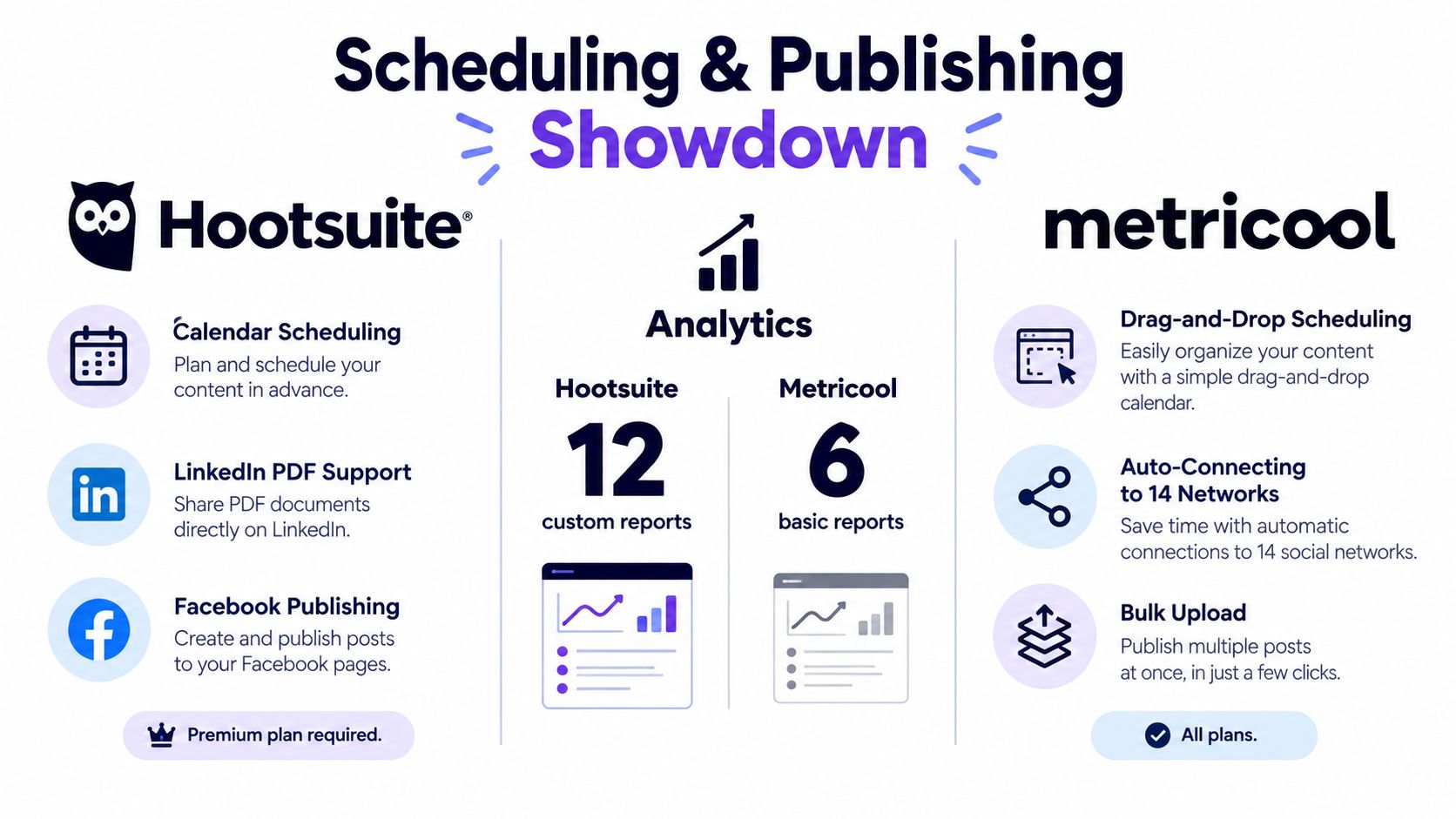
Hootsuite's comparison matrix lists support for publishing LinkedIn PDFs and Facebook group posts, capabilities that the same matrix doesn't list for Metricool. That distinction matters if your content calendar includes document-led LinkedIn posts or communities managed through Facebook groups. A scheduler that handles your preferred format directly removes a manual publishing step.
The matrix also credits Hootsuite with goal-based recommended publish times and broader scheduling controls. Metricool remains relevant for teams that want a visual planning workflow and straightforward account management, but the important question is whether your content mix needs the formats and recommendations Hootsuite specifically supports.
For teams comparing daily publishing mechanics in more detail, this Hootsuite comparison guide provides another reference point. Use it to validate the workflow requirements that matter before treating a feature difference as a buying advantage.
A practical way to assess the difference is to list the posts your team publishes repeatedly:
- Document posts: Do LinkedIn PDFs form part of your standard distribution?
- Community posts: Does your team publish directly to Facebook groups?
- Timing decisions: Do you need goal-based recommendations rather than a simple calendar?
- Approval context: Does someone else need to review content before publication?
If the first three questions describe your operation, Hootsuite's publishing feature set deserves serious weight. If your team primarily needs planning, account organization, and performance visibility, the gap may not justify paying for capabilities you won't use.
Analytics and reporting
Hootsuite's listed advantages are more extensive on the measurement side than many feature summaries suggest. Its comparison matrix includes customizable metrics, social performance scores, Google Analytics and Adobe Analytics integrations, social ROI analysis, industry benchmarking, and scheduled reports. The same matrix shows Metricool as not supporting those specific capabilities.
That doesn't make Metricool weak at reporting. Both tools support paid and organic reporting, white-label reports, and competitive benchmarking, according to the matrix. The difference is the level and type of measurement control. Metricool can fit a team that needs accessible analytics and client-facing reporting. Hootsuite is better aligned with an organization that connects social reporting to wider analytics systems, formal benchmarks, or recurring executive reporting.
Your choice should follow the reporting question you need to answer:
- “Which posts performed best?” Either platform may support the basic review.
- “Can we send a branded report to a client?” Both support white-label reporting.
- “How did social activity contribute to broader business outcomes?” Hootsuite's listed analytics integrations and social ROI analysis become more relevant.
- “Can leadership receive a repeatable report without manual assembly?” Hootsuite's scheduled reports are a meaningful differentiator.
For a smaller operation, advanced reporting controls can become unused complexity. For a mature team, their absence can create spreadsheet work and weaken consistency. The winner isn't determined by the longest feature list. It's determined by whether the feature appears in your recurring workflow.
The social media scheduler app comparison can help you evaluate that workflow at the task level, especially if your team is deciding whether it needs a full enterprise suite or a focused scheduling layer.
The Pricing Crossover Point Most Comparisons Miss
Most comparisons say Metricool is cheaper and stop there. That conclusion is directionally useful, but it doesn't tell an agency whether the difference comes from headcount, client count, or both.
Current comparison material places Hootsuite's entry pricing at about $99 per user per month, with higher tiers around $199 and $399. Metricool is described as starting at about $20 per month, with pricing organized around a brand or account bundle rather than individual seats. Those figures are summarized in Bragly's pricing resource, and buyers should verify current commercial terms before purchasing.
The arithmetic buyers can actually use
The Hootsuite side is easy to model because the price is attached to seats. One entry-level seat is about $99 per month, five seats are about $495 per month, and ten seats are about $990 per month. These are simple multiplications of the cited entry price, not claims about a negotiated or custom contract.
| Team Size | Hootsuite per seat | Metricool per brand |
|---|---|---|
| 1 person | About $99/month | Starts around $20/month, depending on brand bundle |
| 5 people | About $495/month | Brand-based, not five-seat based |
| 10 people | About $990/month | Brand-based, not ten-seat based |
The table exposes the crossover logic, but it also exposes why false precision is dangerous. The available evidence provides Metricool's approximate starting point and its brand-based structure, but it doesn't provide enough detail to calculate a universal price for five or ten brands. A team with one brand and ten users cannot be compared fairly with an agency managing ten brands and one operator.
The defensible conclusion is this: Hootsuite's cost scales directly with user count, while Metricool's listed architecture scales around brands or accounts. Hootsuite becomes materially less attractive when many people need access but the number of brands stays stable. Metricool becomes less obviously economical when brand complexity, collaboration requirements, or unsupported enterprise integrations create operational costs that aren't visible on the invoice.
Three buying scenarios
A solo creator usually evaluates the starting price, onboarding effort, and analytics depth. Metricool's free plan and lower-priced tiers give it a natural advantage for this profile, provided the creator doesn't need Hootsuite's enterprise-oriented controls.
A five-person startup team needs a different calculation. If all five people require Hootsuite seats, the entry-price arithmetic produces a much larger monthly commitment than a single seat. A Metricool plan may avoid that direct seat multiplication, but the buyer still needs to confirm how its brand bundle handles collaboration and account access.
An agency with ten clients should stop comparing software as if it were a single-brand business. The relevant variables are number of clients, number of internal users, reporting needs, and client churn. Per-seat pricing can become painful when account managers, strategists, and approvers all need access. Per-brand pricing can be more predictable for a client-heavy portfolio, but only if the included account capacity matches the portfolio.
That is the crossover most list-price articles miss. There isn't one universal team size at which Metricool wins, because the two tools meter different units. The actual threshold is reached when additional seats grow faster than additional brands, or when Hootsuite's governance value is strong enough to justify the extra seat cost.
For a deeper view of how social software fits into the wider operating budget, see this guide to social media management pricing. Recalculate the decision when your headcount or client roster changes, rather than treating the original subscription choice as permanent.
Which Tool Fits Which Kind of Team
The cleanest verdict is situational. Independent comparisons characterize Hootsuite as the stronger fit for mature organizations that need listening, reporting, and centralized control, while they position Metricool as the lower-cost, analytics-focused option for small businesses and creators. This distinction is supported by iTechGuides' comparison of Hootsuite and Metricool.
Mature organizations
A mature social team often has more than one person touching a post. Marketing may create the content, legal may review it, a regional lead may adapt it, and an executive team may expect recurring performance reporting. Hootsuite fits this environment when centralized control, social listening, and formal reporting integrations matter more than the lowest subscription cost.
The trade-off is straightforward. You pay for a platform designed to coordinate a more complex organization, and the per-user model can become expensive as access expands. That cost may be rational if a publishing error, fragmented reporting process, or missing integration creates greater operational risk.
Small businesses and creators
A creator or small business usually needs a usable calendar, dependable scheduling, and analytics that don't require an operations team to interpret. Metricool's free plan and lower-priced tiers make it the more natural starting point for buyers who prioritize value and quick setup.
The trade-off is capability scope. A smaller operator may not miss advanced governance, but a growing organization could eventually need stronger collaboration, listening, or integrations than the simpler workflow provides.
Agencies and freelancers
Agencies have a different pressure point. They add and remove brands, prepare client reports, and often need to keep delivery consistent without assigning an expensive seat to every person involved. Metricool's brand-based approach can make more sense for this pattern, especially when analytics and white-label reporting are central deliverables.
An agency should still test approval requirements before committing. If clients expect formal review chains, centralized permissions, or enterprise-level monitoring, Hootsuite's operational controls may outweigh its price disadvantage.
Decision test: If your bottleneck is understanding performance, start with Metricool. If your bottleneck is controlling people, approvals, and conversations, start with Hootsuite.
For teams comparing several accounts at once, this guide to the best social media scheduler for multiple accounts offers a useful workflow lens. The right choice is the one that removes your most expensive recurring bottleneck, not the one that wins the most generic category labels.
When a Third Option Beats Both
Some teams don't need a large enterprise suite, but they also don't want a reporting-first product that leaves their broader publishing workflow fragmented. They may manage several platforms, tailor captions for each channel, organize campaigns by content pillar, and need predictable pricing without adding a seat or channel charge every time the operation expands.
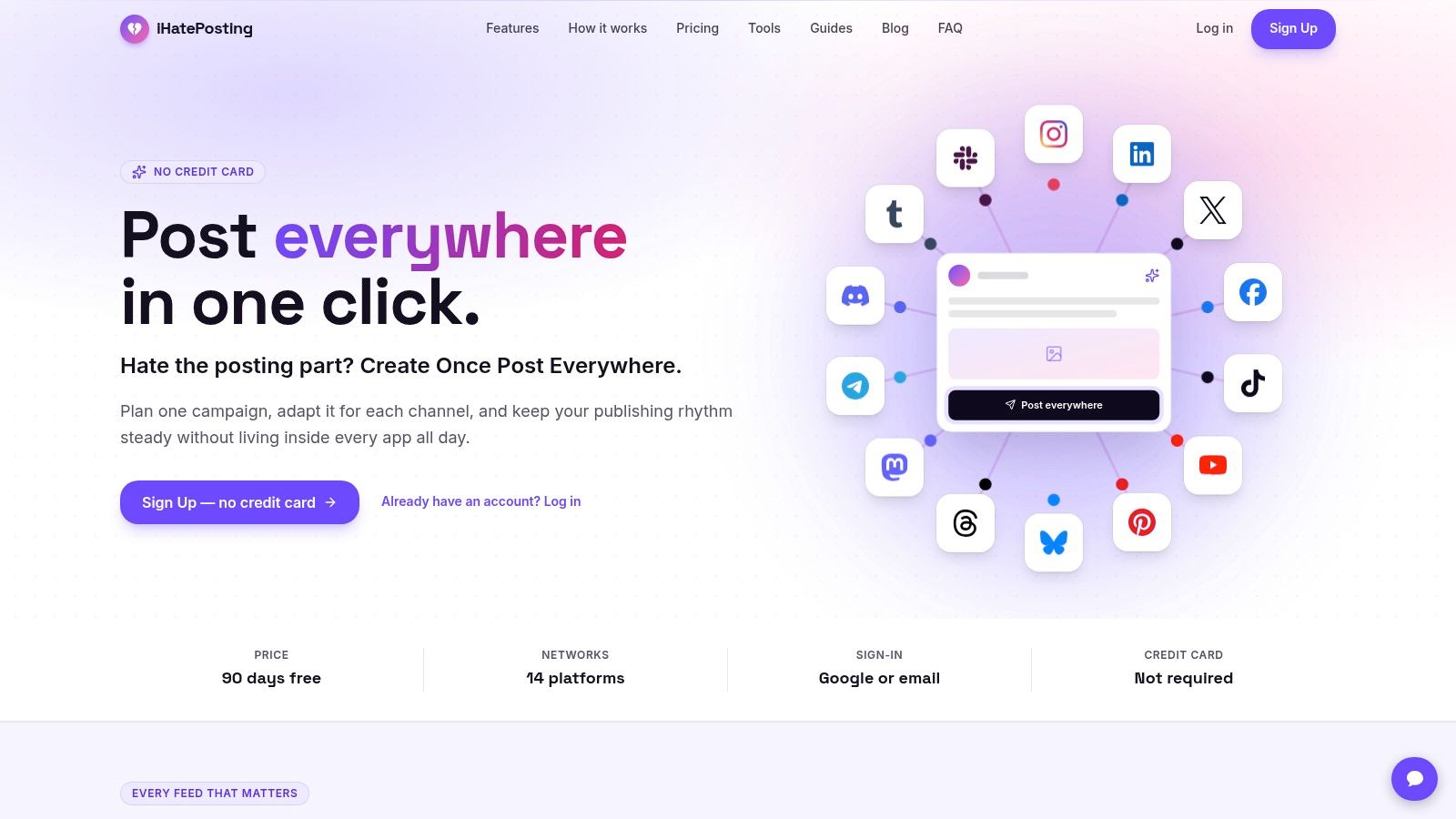
iHatePosting provides a third path for that profile. It brings scheduling across fourteen networks into one composer, including Instagram, LinkedIn, Facebook, TikTok, YouTube, X, Bluesky, Threads, Mastodon, Telegram, Discord, Tumblr, Pinterest, and Slack. Its workflow includes a visual calendar, platform-specific previews, caption tools, campaign organization, analytics, and best-time recommendations based on the account's own data.
Where the third path fits
The operational difference is less about adding another dashboard and more about reducing repeated work. A team can keep the creative attached to the post, tailor each caption, preview platform-specific output, and group content by a launch or content pillar rather than maintaining disconnected planning systems.
Its pricing structure also addresses the problem identified earlier. The product uses flat pricing without per-seat or per-channel charges, which gives multi-platform teams a more predictable way to model growth. That doesn't automatically make it the right choice, because predictable pricing can't replace a capability your organization depends on.
Use this option when:
- Platform breadth matters: Your team publishes across mainstream and community-oriented networks from one workflow.
- Content organization is the problem: Campaigns, launches, and content pillars need to stay visible in one calendar.
- Team size is fluid: You want to avoid making every additional seat or channel a separate pricing event.
- Enterprise governance isn't the priority: Your team doesn't require Hootsuite's listening tools, deep integrations, or centralized controls.
Don't use it as a substitute for Hootsuite when social listening and enterprise integrations are essential. Don't choose it over Metricool solely because it offers more networks if your operation is primarily an analytics and client-reporting function. Its value appears when workflow clarity and multi-platform coverage matter as much as measurement.
The broader social media scheduler comparison can help teams decide whether their primary need is reporting depth, governance, or a unified publishing workflow.
Final Recommendation and How to Switch Tools
There isn't one winner for every buyer.
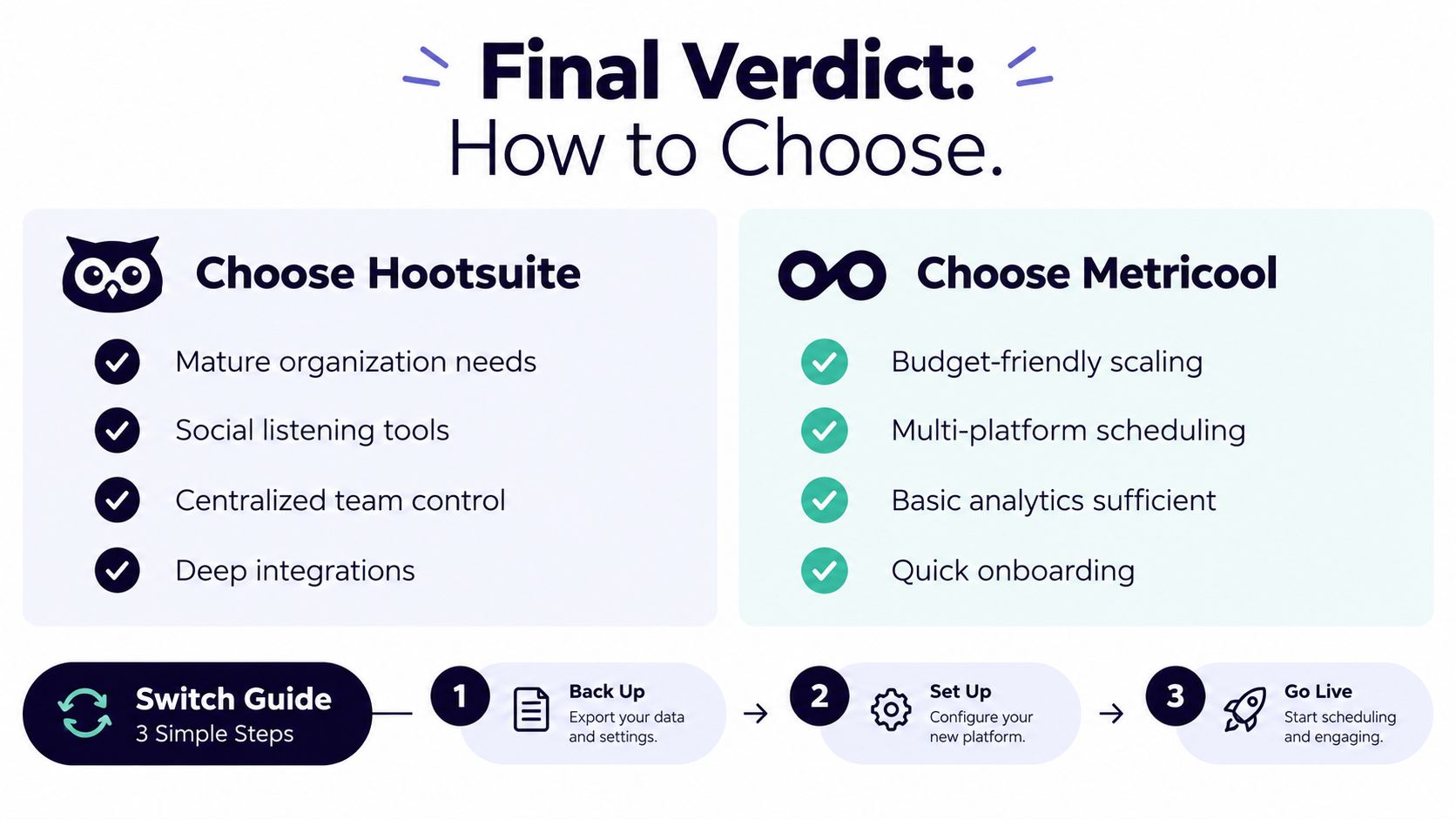
Choose Hootsuite if you run a mature organization that needs social listening, centralized control, formal reporting, and integrations with broader analytics systems. Its per-seat cost is easier to justify when governance prevents real workflow risk.
Choose Metricool if you're a creator, small business, freelancer, or analytics-focused agency that values accessible reporting, white-label deliverables, and lower-cost entry options. Its brand-based pricing can be more suitable when your operation adds clients more often than internal users.
Choose iHatePosting if your priority is a unified composer for many networks, platform-specific tailoring, campaign organization, and flat pricing without per-seat or per-channel charges. It won't replace enterprise listening or deep governance, but it can fit teams whose main problem is fragmented publishing.
If you're switching tools, protect continuity before canceling the old subscription:
- Export scheduled content and reporting assets. Save calendars, captions, media, report templates, and account notes in formats your new workflow can use.
- Reconnect accounts and rebuild permissions. Confirm every social profile, user role, approval path, and publishing authorization before moving live content.
- Run both systems in parallel. Test upcoming posts, reporting, and account access before ending the old plan. Re-establishing historical analytics may require a separate archive because a new platform won't automatically reproduce every prior report.
Revisit the decision whenever your user count, brand portfolio, or governance requirements change. Pricing architecture, not feature volume alone, is often what eventually forces a team to switch.
If your team needs one place to plan, tailor, and schedule content across multiple social networks, iHatePosting offers a visual calendar, platform-specific publishing workflow, campaign organization, and flat pricing without per-seat or per-channel charges. Try it alongside your current scheduler and compare the workflow before making a permanent move.