Social Media Management Pricing: 2026 Cost Guide
17 min readsocial media management pricingsocial media pricingagency pricingfreelancer rates
Most social media management services in 2026 cluster around $1,000 to $3,000 per month, while SaaS scheduling tools usually land between $6 and $200 per month depending on tier. That gap tells you the real story: you're not comparing prices, you're comparing bundles of labor, workflow, and accountability.
A lot of buyers ask the wrong question. They ask, “What does social media management cost?” Vendors love that question because it lets them anchor you on a monthly retainer before they've defined the work. The better question is, “What exactly is included, and what should that scope reasonably cost for my business?”
That's where social media management pricing gets messy. One quote covers scheduling and basic reporting. Another includes strategy, creative, approvals, community management, and short-form video. Both get called “management.” They are not the same product.
The market data makes that obvious. Tool pricing stays relatively low because software handles publishing, planning, and analytics at scale. Service pricing jumps fast because people are doing the work, and people are expensive, especially when the scope includes content creation, revisions, reporting, or cross-platform coordination.
If you buy social media often enough, you stop reading package names and start reading line items. That's the only way to separate a fair quote from an inflated one.
Table of Contents
- What You'll Actually Pay for Social Media Management in 2026
- The Four Pricing Models Every Vendor Uses
- Real Cost Ranges by Provider Model
- The Five Factors That Move Your Price
- Building a Defensible Budget Before You Buy
- Hiring a Person vs Buying a Tool
- Negotiation Tactics That Actually Lower the Bill
- Matching Your Budget to the Right Path
What You'll Actually Pay for Social Media Management in 2026
The cleanest way to think about social media management pricing is to separate software from services.
On the software side, Buffer's 2026 roundup of social media management tools shows starter plans around $6 to $20 per month, professional plans around $50 to $200 per month, and enterprise plans at $300+ per month or custom pricing. It also notes a long-running pattern in this category: many tools charge by user or connected account, which is exactly why costs can climb fast for agencies and teams managing multiple brands.
On the services side, SocialRails' 2026 pricing guide says most businesses land in the $500 to $5,000 per month range, with many clustering around $1,000 to $3,000 per month for ongoing support. The same guide cites a pricing survey where 52% of businesses spend between $100 and $5,000 per month on social media management. That's a huge spread, and it exists because the category includes everything from low-cost schedulers to full-service retainers.
Why the range is so wide
You're usually choosing between four provider paths:
- SaaS tools for planning, scheduling, and basic analytics
- Freelancers for lean execution and some strategy
- Agencies for broader delivery, specialization, and account management
- In-house hires when social becomes an ongoing operating function
The pricing difference comes down to what gets bundled. A tool helps you publish. A freelancer might also write captions and manage a calendar. An agency may add approvals, design, reporting, and meetings. An in-house person becomes part of your daily business rhythm.
Practical rule: If two vendors use the same label but define the work differently, ignore the label and price the scope.
That's also why package menus are a weak buying tool. They're built to simplify selling, not to make procurement easier. If you want a cleaner benchmark before you compare quotes, start with a direct look at social media scheduler pricing and plan structure, then add only the labor you need.
What a fair process looks like
A fair buying process starts with your scope, not theirs. List the channels, posting cadence, content formats, review process, community workload, and reporting needs. Then ask which provider type fits that scope with the least overhead.
That's the only way to avoid paying agency rates for scheduler-level work, or expecting a low-cost tool to replace actual human execution.
The Four Pricing Models Every Vendor Uses
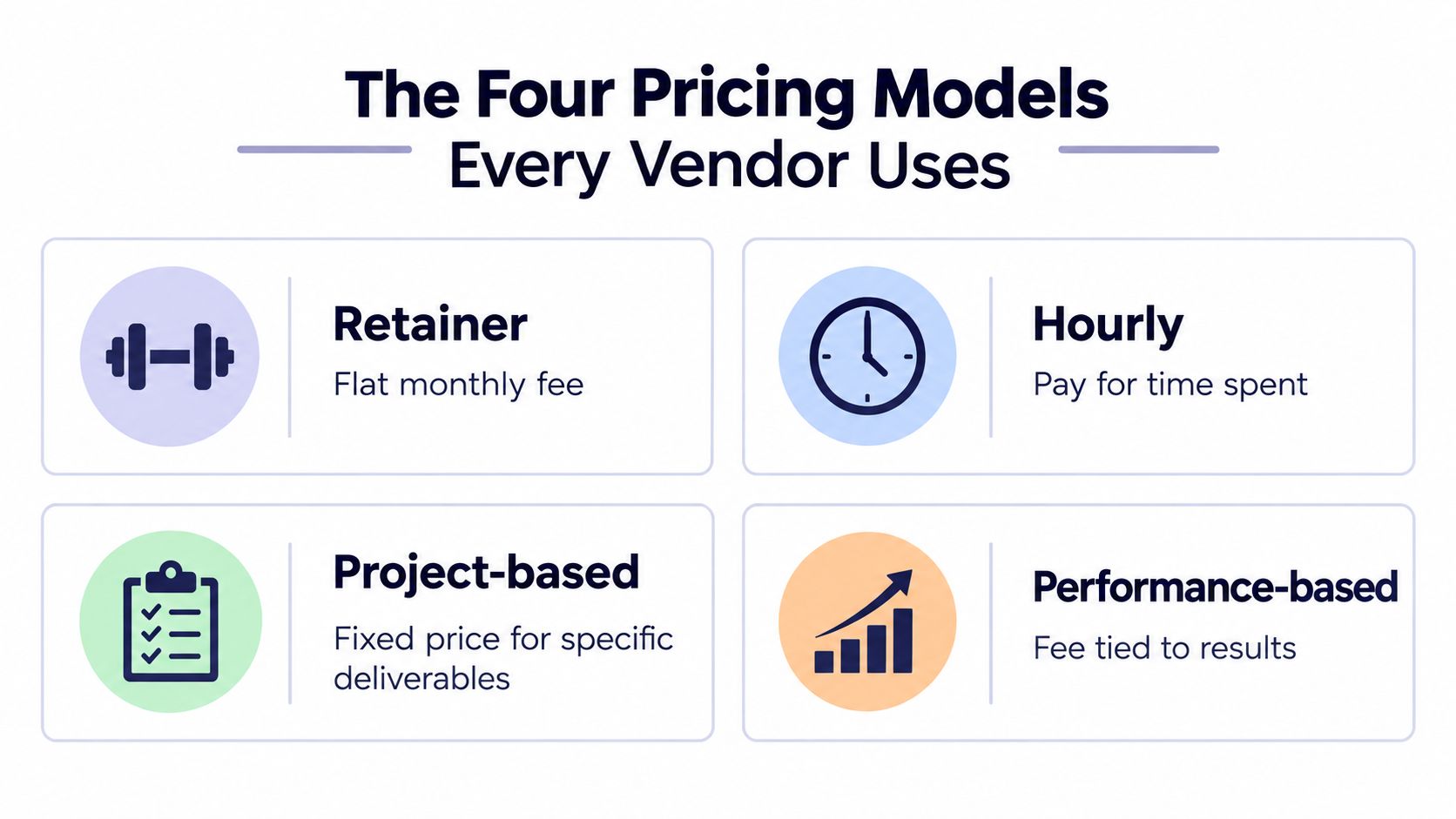
Most quotes look custom. They usually aren't. Vendors tend to package social media management pricing in the same handful of ways, and once you recognize the model, you can spot where the bill is likely to drift.
Retainer pricing
This is the gym membership model. You pay a flat monthly fee for an agreed scope.
Retainers work well when social is ongoing and the workload is predictable. They're also the easiest structure for agencies to sell because they smooth revenue and give them room to absorb lighter and heavier weeks. For buyers, the upside is clarity. The downside is complacency. If the scope isn't tightly defined, the vendor keeps the flat fee while shrinking output.
Per-post pricing
This is à la carte dining. You pay for each post, asset, or deliverable.
It can make sense for campaigns, launches, or brands that only need periodic help. It breaks down when you need calendar planning, approvals, engagement, or strategy. Social management isn't just the published post. It's the drafts, revisions, coordination, and follow-through around it. Per-post quotes often look cheap until all of that gets billed separately.
Hourly pricing
This is the contractor's time card. You pay for time spent.
Hourly billing is transparent on paper. In practice, it can punish efficiency and reward revision cycles. If your internal team is slow to approve, hourly can get ugly fast. If the provider is disciplined and the scope is fuzzy, hourly can still be useful for short audits or transitional work. I rarely like it for steady-state management because buyers end up funding process drag.
A vague scope plus hourly billing is where “small tweaks” turn into expensive months.
Per-platform pricing
This is the cable bundle model. Each network gets priced separately.
That can be fair when platforms truly require different workflows. It can also be a lazy markup strategy. The danger is obvious. Add a third or fourth channel and your quote jumps, even when much of the planning and reporting work is shared.
Agency benchmarks compiled by PixelCrayons note that per-platform pricing typically lands at $500 to $800 per platform per month, community management averages about $1,400 per month, and the average social media platform management retainer is around $3,000 per month. That makes per-platform pricing one of the easiest places for costs to stack quickly.
Hybrid models are where padding hides
Some vendors combine a monthly retainer with separate fees for paid social support, creative production, reporting dashboards, or account-based add-ons. Those hybrid quotes often look polished and oversized at the same time.
If the proposal mixes several pricing models, force the vendor to separate them. You should be able to see what you're paying for ongoing management, what you're paying for production, and what you're paying for extras.
Real Cost Ranges by Provider Model
The fastest way to waste money is to compare an agency retainer to a scheduling subscription as if they're substitutes. They aren't. You're buying from different cost structures.
Pallyy's 2026 pricing guide is useful here because it highlights what most guides miss: pricing only makes sense when you tie it to what's included. It notes that freelancers are often cited around $500 to $2,500 per month, small agencies around $1,000 to $5,000, and enterprise retainers above $10,000, with higher prices tied to video production, community management, and reporting complexity.
Side-by-side market view
| Provider | Monthly Range | Typical Scope | Where Quotes Inflate |
|---|---|---|---|
| SaaS tool | Low monthly software cost to professional tool pricing | Scheduling, calendar, approvals, analytics, publishing workflow | Extra seats, connected accounts, premium analytics |
| Freelancer | $500 to $2,500 | Posting, caption writing, light content support, some strategy | Revision rounds, extra platforms, ad hoc design |
| Small agency | $1,000 to $5,000 | Multi-platform execution, account management, reporting | Meetings, “strategy” layers, creative add-ons |
| Mid-tier to enterprise agency | $2,500 to $7,500, and $10,000+ for enterprise-level programs | Broader content ops, campaign coordination, community, analytics, paid alignment | Paid social fees, custom dashboards, production markups |
| Per-platform benchmark | $500 to $800 per platform per month | Platform-specific management | Channel stacking |
| Community management add-on | Around $1,400 per month | Replies, monitoring, inbox handling | Extended hours, escalation handling |
What the low end usually means
At the bottom of the market, you're buying execution, not much else. That can be perfectly fine.
A freelancer near the lower end often handles one or two channels, posting from existing assets, with light copy and limited planning. A small agency near its lower tier may do something similar but with more process and more account overhead. The minute you add custom content, short-form video, or active community work, that low-end quote stops being realistic.
What the higher bands usually include
The upper bands start to make sense when the vendor is coordinating several moving parts. More channels. More stakeholders. More content formats. More review cycles. More reporting.
That's where some brands should compare agencies against a tool-first workflow instead of defaulting to full service. If your team can handle strategy and approvals internally, a scheduler like this Buffer vs. Hootsuite comparison can help you see whether you really need service labor or just better publishing infrastructure.
If a quote rises mainly because the vendor added process around the work, ask whether your team actually benefits from that process.
The Five Factors That Move Your Price
Vendors don't pull numbers from thin air. They price around workload. The problem is that buyers often underestimate which parts of the workload are expensive.
Platform count
This is the most underrated pricing lever.
Managing one platform well is manageable. Managing several platforms means different post formats, different audience expectations, different review needs, and different performance reads. Even when the core message stays the same, execution rarely does. Buyers who assume a third channel is a minor add-on usually overpay because they haven't forced the vendor to explain the extra work.
Posting frequency
Cadence matters, but not in a perfectly neat way.
A light schedule is usually straightforward. As frequency rises, workflow complexity rises with it. Teams need content batching, stronger approvals, more organized asset handling, and tighter calendar discipline. Daily posting changes the operating model. It's no longer “make a few posts.” It becomes a production system.
Content type
Pricing gets distorted fastest here.
Plain-text updates and lightly designed posts are one thing. Carousels, short-form video, UGC-style content, creator coordination, and campaign-specific creative are something else entirely. When vendors quote a low monthly fee up front and then bolt on production later, this is usually where they do it.
Strategy depth
Not every brand needs an agency strategy layer every month. Many don't.
But if you want audience research, message testing, channel priorities, campaign themes, and performance interpretation that affects future content, that is real work. The mistake is letting vendors bury basic calendar planning inside a line item called “strategy” and charging premium rates for routine scheduling decisions.
Reporting complexity
A monthly summary is normal. A decision-ready reporting setup takes more effort.
If the vendor is connecting social activity to downstream business outcomes, the price should rise. If they're sending a long slide deck full of vanity metrics and recycled screenshots, it shouldn't.
| Factor | Baseline (lower band) | Mid-range | Premium add-on | Typical cost added |
|---|---|---|---|---|
| Platform count | One or two channels | Several active channels | Broad multi-channel coverage | Costs rise as channels stack |
| Posting frequency | Light recurring cadence | Consistent weekly volume | Daily publishing rhythm | Increases with batching and approvals |
| Content type | Simple posts from existing assets | Designed graphics and carousels | Short-form video, UGC, creator coordination | Usually the fastest driver of quote inflation |
| Strategy depth | Basic calendar planning | Ongoing planning and optimization | Research, audits, structured strategic input | Pushes execution into advisory pricing |
| Reporting | Basic monthly recap | Custom reporting views | Dashboards and business-linked analysis | Adds labor when reporting informs decisions |
Buying rule: If a vendor can't show which of these five factors moved the quote, the quote isn't ready for approval.
Building a Defensible Budget Before You Buy
Most buyers walk into vendor calls underprepared. Then they let the seller teach them what the work “should” cost. That's backwards.
Build your budget first. Then use vendor quotes to pressure-test it.
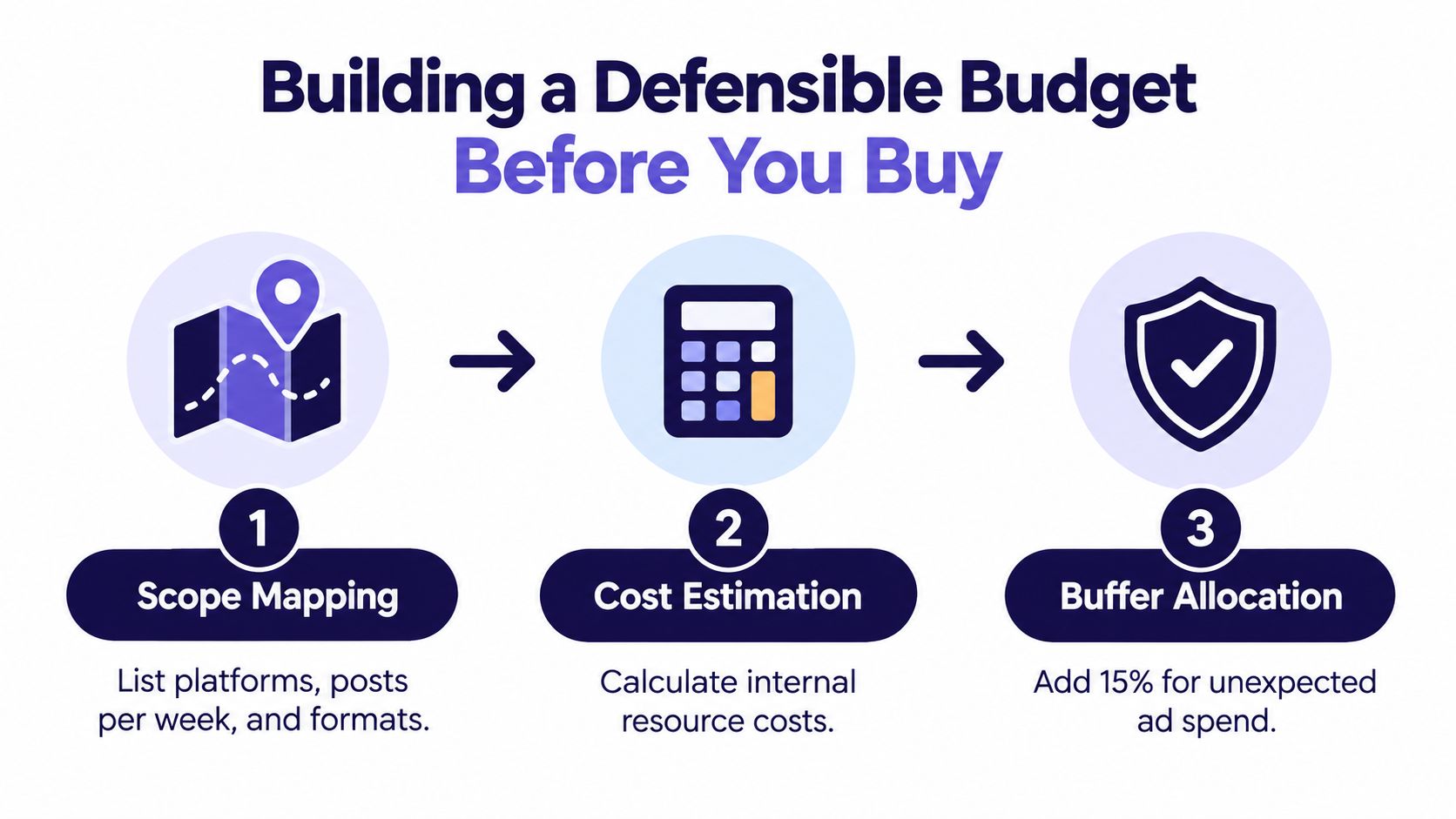
Step one is scope mapping
Write the work in plain English before any vendor rewrites it into package language.
Use a short worksheet:
- Platforms: Name each channel you want managed.
- Cadence: State how often you need posts and whether timing matters.
- Formats: Note whether this is text, graphics, carousels, video, or a mix.
- Ownership: Clarify who provides source material, who writes, who designs, and who approves.
- Support layers: State whether community replies, strategy, and reporting are in or out.
That simple list does more for budget accuracy than most discovery calls.
Step two is labor estimation
Now translate the scope into time. Don't pretend this is perfect. It doesn't have to be. It needs to be sane.
Estimate where the work sits on a spectrum:
- Posting-only work: Lighter execution burden
- Posting plus light content creation: Moderate recurring labor
- Strategy, reporting, and heavier production: Senior attention, more coordination, more revisions
Then separate execution labor from strategic labor. That matters because many inflated quotes hide junior work inside premium language.
If you're leaning toward software-first execution, free social media scheduling software options can help you estimate how much of the process can be handled by tools before you buy service hours.
Step three is sanity checking
Now compare your internal estimate against market reality.
If your scope is narrow and a quote comes back loaded with account management layers, workshop hours, or dashboard fees, you've found the markup. If the quote is higher because the scope includes real creative production or complex stakeholder management, that's a different conversation.
Use a simple budget template:
| Scope line | Estimated effort | Delivery type | Monthly subtotal |
|---|---|---|---|
| Platform management | Internal estimate | Execution | Calculated by your team |
| Content creation | Internal estimate | Execution or production | Calculated by your team |
| Strategy and planning | Internal estimate | Senior advisory | Calculated by your team |
| Reporting and reviews | Internal estimate | Analysis | Calculated by your team |
| Revision buffer | Add a modest contingency | Workflow overhead | Included deliberately |
Add a buffer for approvals and revisions. Buyers who skip that step end up pretending every month will run cleanly. It won't.
Hiring a Person vs Buying a Tool
This decision gets framed too emotionally. People say they want “support” when what they really need is either software or labor. Those are different purchases.
Scenario one is a tool-first business
A solo founder posting a few times a week across a couple of channels usually doesn't need a retainer. They need a scheduler, a repeatable workflow, and the discipline to batch content.
In that case, software often wins. The work is mostly planning, formatting, timing, and publishing. A good tool can handle that without adding account management overhead or forcing the founder into a monthly contract.
A platform like this social media scheduling tool overview helps in exactly that kind of setup, where the problem is publishing consistency rather than outsourced production.
Scenario two needs actual labor
A brand publishing constantly across several networks, coordinating creators, gathering UGC, and reviewing performance every month is not buying a scheduler problem. It's buying people work.
No current tool writes creator briefs, chases approvals, resolves brand feedback, and handles community nuance on its own. Software can support the workflow, but it doesn't replace the operator.
| Scope level | SaaS cost /mo | Junior freelancer /mo | Senior freelancer /mo | Best fit |
|---|---|---|---|---|
| Light scheduling and analytics | Lower software tiers | Often unnecessary | Usually unnecessary | Tool |
| Recurring posting with light support | Professional software tier | Viable | Possible but often overkill | Tool or junior freelancer |
| Multi-platform content execution | Higher-tier software plus labor | Viable | Viable | Freelancer |
| Ongoing strategy, content, and coordination | Software supports workflow only | Sometimes stretched | Better fit | Person or agency |
Where the real breakpoint sits
SaaS replaces a junior freelancer when the scope is mostly posting and analytics.
Once you add content creation, community management, or strategy, labor becomes the main cost driver again. At that point, don't buy more software hoping to avoid people costs. Buy the right amount of labor and keep the tool stack lean.
Negotiation Tactics That Actually Lower the Bill
Most buyers negotiate price too late. By the time they start pushing back, the vendor has already framed the work in a way that makes the quote feel inevitable.
Start earlier. Challenge the structure, not just the total.
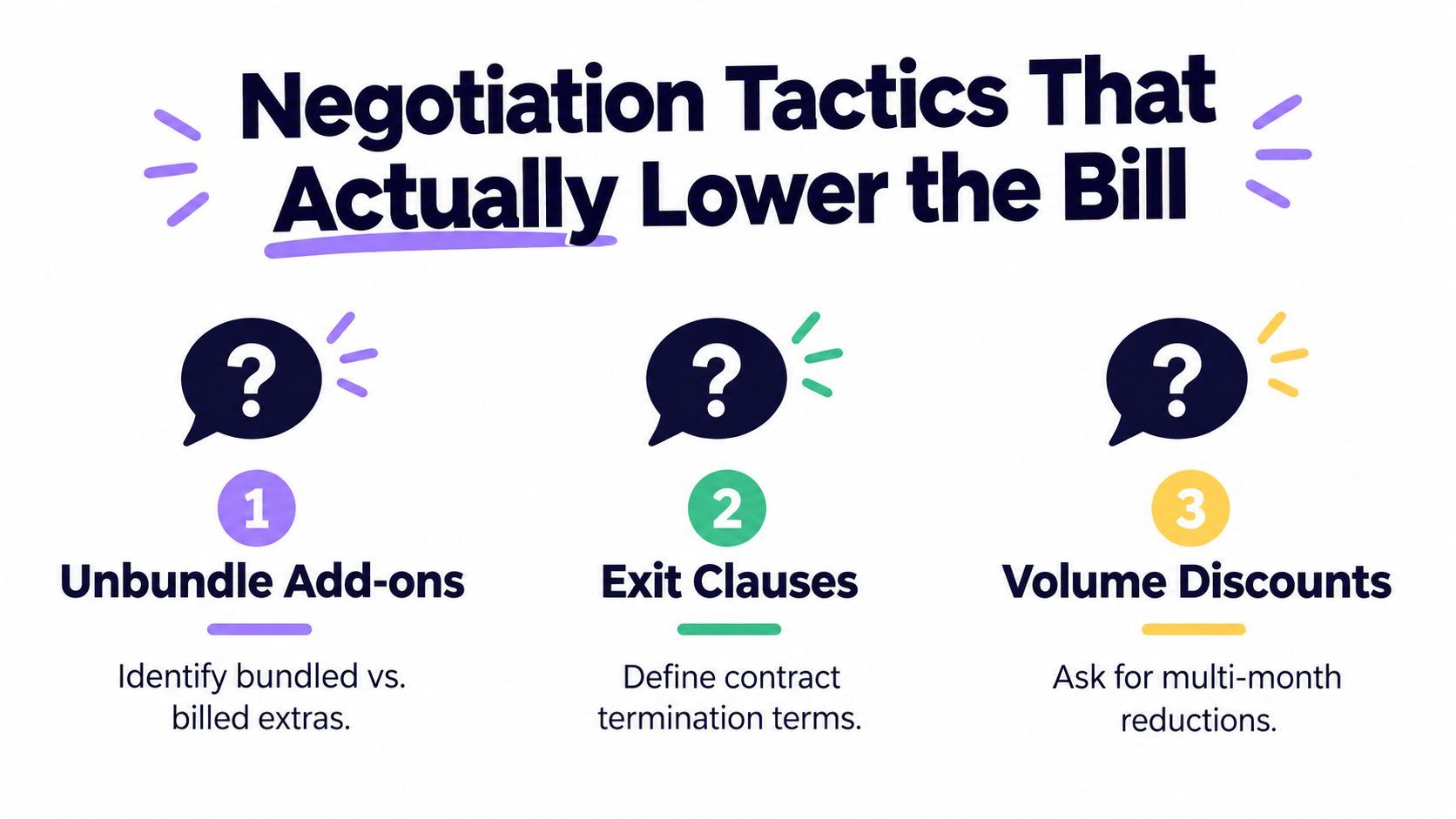
Ask these three questions before you discuss discounts:
- What is bundled and what is billed separately? This exposes padded retainers and hidden production fees.
- What happens if we cancel after 60 days? This exposes whether the deal depends on lock-in more than performance.
- Which tasks are automated and which are human-led? This tells you whether you're paying premium labor rates for work software already handles.
The line items I challenge first are predictable. “Strategy” that's really a content calendar. Custom reporting decks nobody uses. Paid social fees stacked on top of organic management without clean separation. Creative production priced vaguely enough that revisions become a profit center.
Here's the embedded video if you want a quick visual on negotiation framing before your next quote review:
Counter-moves that work
Use direct terms:
- Cap revisions: Set a fixed number of rounds for creative.
- Name strategy outputs: If strategy is real, it should produce defined deliverables.
- Split paid and organic: Different scopes, different economics.
- Replace the giant deck: Ask for a concise executive summary tied to decisions.
Your best leverage is a clear walk-away budget. If you don't set one, the vendor's first number becomes the negotiation center.
If timing is flexible, ask about prepay discounts or end-of-quarter flexibility. But don't get distracted by small concessions on a bloated scope. The big savings come from unbundling.
Matching Your Budget to the Right Path
Most overpayment happens because buyers choose the wrong operating model for their stage. They hire an agency when they need a tool. Or they force a freelancer to act like a content team.
Four buyer profiles that actually matter
| Buyer Profile | Monthly Budget | Recommended Path | Overpaying Signal | First 7-Day Action |
|---|---|---|---|---|
| Solo founder on one to two channels | Software-tier budget | SaaS plus founder-led engagement | Paying for meetings and account management | Audit your current posting workflow |
| Small business needing steady execution | Freelancer-level budget | Narrowly scoped freelancer retainer | Buying strategy you won't use | Define exactly what content you need |
| Growth-stage brand across several channels | Agency or fractional setup budget | Boutique agency or fractional lead plus software | Paying for broad retainers without clear ownership | Split execution from strategy in your brief |
| Mid-market brand with compliance and coordination needs | Enterprise budget | Agency program or in-house team with enterprise software | Outsourcing basic posting at enterprise rates | Document approvals, stakeholders, and content risk |
A lot of teams also need a better view of how AI affects commercial outcomes before they decide between labor and tooling. If that's your situation, this piece on AI for social media revenue is worth reading because it connects workflow choices to business impact instead of treating AI as a gimmick.
My blunt recommendation by stage
If you're early, stay lean. Buy infrastructure first. A scheduler, a calendar, and a consistent publishing habit beat a bloated retainer.
If you're growing and social is now operationally important, pay for labor where humans matter. Content production, community nuance, approvals, and strategic judgment. Keep software in the background doing the repetitive work.
If you're not sure where you sit, compare your current needs against practical scheduler options like these social media scheduling platforms. That usually makes the gap between tool-level needs and service-level needs obvious very quickly.
The right budget is the one that matches your real scope, not the one a vendor normalizes in a proposal.
iHatePosting gives teams a way to handle the software side of social media management without buying a full-service retainer just to stay organized. If your bottleneck is planning, tailoring, and publishing across multiple networks, it's worth looking at iHatePosting before you commit to agency-style overhead.