Evergreen Content Meaning and Strategy for Lasting Reach
14 min readevergreen contentcontent strategysocial mediacontent marketing
Evergreen content is material built around stable audience demand, so it can keep earning discovery long after publication. It describes a topic's lifespan, not a promise that every detail on the page will remain accurate without maintenance.
The popular advice to “publish once and forget it” gets the central idea wrong. A durable guide can keep answering the same recurring question while its examples, screenshots, statistics, tools, and recommendations become outdated. The content lasts because the problem persists, not because the page is permanently fresh.
That distinction matters for a small publishing team. You need a calendar that protects durable topics, leaves room for timely ideas, and gives someone a clear reason to revisit older assets. Without that rhythm, an evergreen library gradually turns into a collection of outdated instructions that still look authoritative.
Table of Contents
- What Evergreen Content Means
- The Three Layers Behind Every Evergreen Piece
- Evergreen Formats That Travel Well on Social
- Evergreen vs Trend-Based Content in a Real Calendar
- Building Evergreen Posts Without Burning Out
- The Maintenance Loop That Keeps Evergreen Alive
- Measuring Longevity and ROI the Right Way
- Putting It All Together for Long-Term ROI
What Evergreen Content Means
Evergreen content is built around a question or problem that keeps returning, so the page can remain useful and discoverable after publication. Its defining feature is stable audience demand, not permanent accuracy. Readers may continue seeking the same answer while examples, interfaces, evidence, and recommendations change. Ahrefs' explanation of evergreen content makes this distinction between a durable topic and a page that never needs revision.
A tutorial on building a content calendar can fit this definition. A post tied to one viral trend usually cannot. Definitions, checklists, foundational explainers, troubleshooting guides, and best-practice resources can keep attracting readers because the underlying intent persists. The format supports longevity, but recurring demand does the actual work.
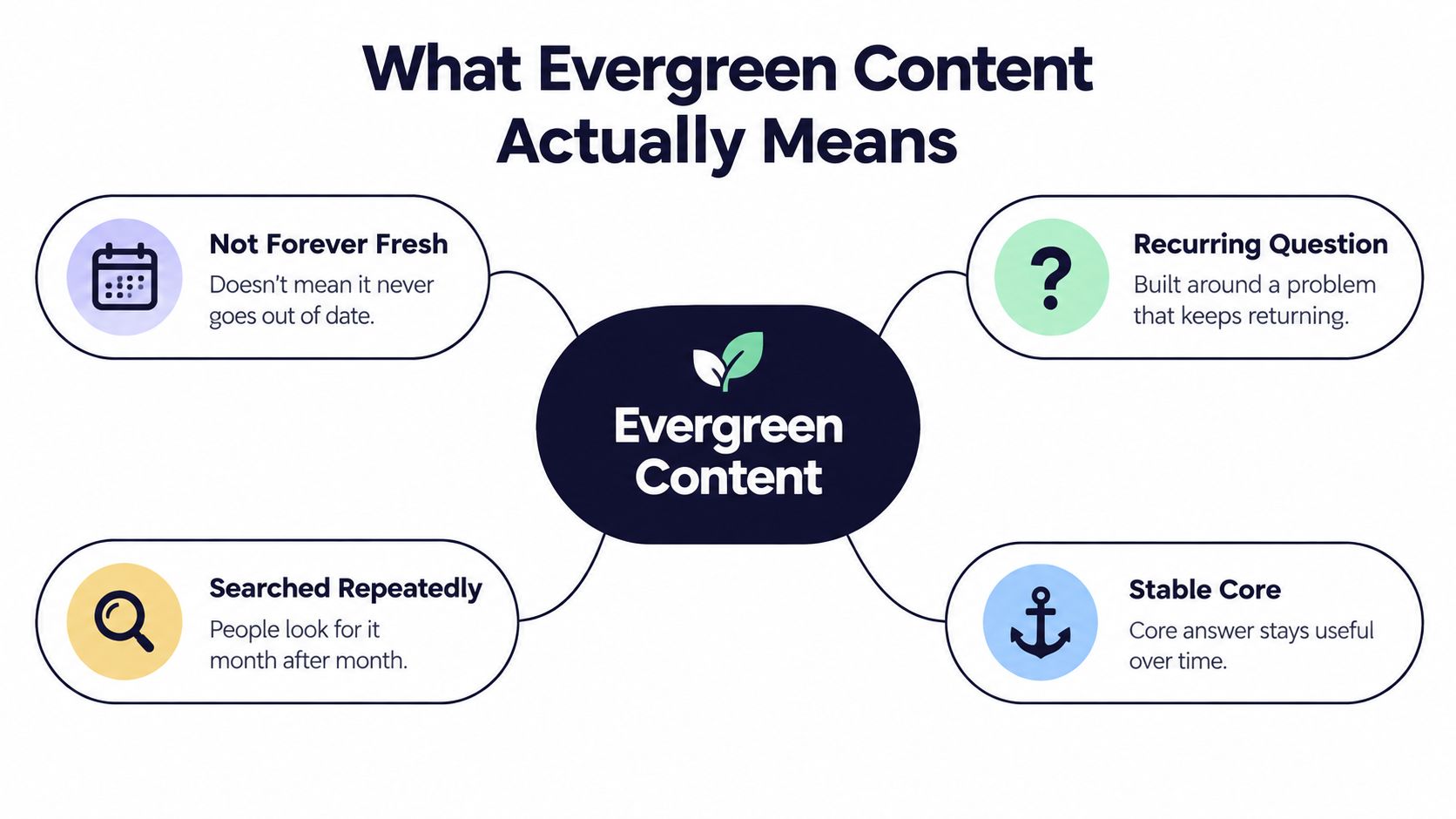
Stable demand is not permanent accuracy
Google introduced the Query Deserves Freshness concept in 2007, distinguishing subjects that need recently published results from stable topics that do not benefit from constant recency. A foundational explanation may stay useful for years, yet its evidence or instructions can still expire. A scheduler can help a small team assign a review date, replace outdated details, and keep the durable idea intact.
Use this test before adding a draft to an evergreen backlog:
- Recurring problem: Will people still try to solve it after the current trend ends?
- Stable core: Can the central answer stand without a temporary event, person, or platform feature?
- Refreshable details: Can examples and instructions change without rebuilding the argument?
- Ongoing intent: Will readers seek the answer repeatedly, rather than only during a news cycle?
A content pillar should pass all four checks. Related ideas can then be grouped through content pillars, keeping durable subjects distinct from trend-led posts and hybrid pieces that pair a stable lesson with a temporary hook.
Practical rule: Evergreen describes how long usefulness may last. It does not promise that every sentence can remain untouched.
The Three Layers Behind Every Evergreen Piece
An evergreen article becomes easier to maintain when you separate its stable problem, changing solution, and distribution format. These layers often get mixed together during drafting, which makes a page harder to update. A writer may treat an old screenshot as part of the core answer, even though the screenshot is only a temporary illustration.
Layer one is the stable problem
Start with the need that keeps returning. For a social media planning guide, the stable problem is not “how to use this year's scheduling interface.” It's how to organize ideas, coordinate publishing, adapt content for different audiences, and maintain a consistent presence without losing control of the calendar.
That problem can support a social media campaign planner, even if the recommended tools change. The page's foundation should explain the planning logic, the decisions a team must make, and the sequence that helps those decisions fit together.
Layer two is the changing solution
The solution includes anything that can age: platform limits, posting recommendations, product capabilities, regulations, examples, benchmark data, and screenshots. These details make a guide practical, but they also create maintenance work.
For example, a planning guide might recommend reviewing each platform's native format before publishing. That principle is durable. The exact video dimensions, caption limits, API behavior, or available scheduling options may not be.
Layer three is distribution
The same idea changes shape as it moves across channels. A long explanation may become a carousel, a short video, a text post, or an email prompt. Distribution formats evolve faster than the underlying problem, so your team should preserve the lesson while adapting the presentation.
This model gives you a simple editing question: Is this passage part of the foundation, or is it a surface detail? Protect the foundation. Recheck the surface.
Evergreen Formats That Travel Well on Social
The best evergreen formats answer a question directly and give readers something they can apply. They also break into smaller pieces without losing their meaning, which makes them useful for social distribution.

Start with formats that have a clear job:
- Definitions: Explain an important term in plain language, then show where it matters.
- How-to guides: Break a repeatable task into decisions and actions.
- Checklists: Turn a process into a pre-publish or troubleshooting routine.
- Foundational explainers: Teach the concepts readers need before they can use advanced tactics.
- Troubleshooting resources: Address recurring errors and show how to diagnose them.
- Best-practice guides: Present principles that remain useful even when individual tools change.
A content calendar guide can become a sequence of posts about choosing pillars, reviewing a draft, adapting a caption, and checking a campaign before publication. Reusable content repurposing strategies can help you turn one strong explanation into several native pieces without copying the same paragraph everywhere.
Formats that look durable but decay
Some assets appear evergreen because they answer a broad question, yet their supporting material ages quickly. A statistic roundup becomes unreliable when its evidence changes. A tutorial filled with interface screenshots becomes confusing after a redesign. A list of platform features can mislead readers when products add, remove, or restrict capabilities.
Before scheduling a repeat promotion, inspect the claims and the visuals. Replace obsolete examples, remove unnecessary dates, and make sure the post still reflects the reader's current task. A carousel can teach a durable framework, but each slide should earn its place rather than preserve an old interface for its own sake. A practical guide to creating an Instagram carousel can help you translate the idea into a format readers can scan and save.
Here's a short video prompt for thinking about reusable content in practice:
A scheduler supports this process when it keeps the source idea, caption variants, visual assets, and campaign context together. The point isn't to publish an identical message across every network. It's to preserve the useful lesson while adapting its length, tone, format, and call to action for each audience.
Evergreen vs Trend-Based Content in a Real Calendar
Evergreen and trend-based content serve different jobs. Evergreen pieces build a durable answer library and can be rediscovered over time. Trend-based posts create urgency, join current conversations, and give people a reason to pay attention now.
A calendar dominated by only one type becomes unbalanced. A library of durable explainers may feel dependable but disconnected from current conversations. A stream of trend posts may create activity without leaving behind useful resources that support future discovery.
| Dimension | Evergreen content | Trend-based content |
|---|---|---|
| Audience need | A recurring problem or question | A current event, conversation, or development |
| Useful lifespan | Long, with maintenance | Shorter and tied to context |
| Primary role | Teach, support discovery, and build a reference library | Create urgency, participation, and timely attention |
| Maintenance | Review details as they change | Check relevance before the moment passes |
| Best reuse | Adapt the core lesson into multiple formats | Archive the lesson or connect it to a durable resource |
A strong calendar lets the two types support each other. A trend post can introduce a current example, then direct readers to a foundational guide. The evergreen guide can later be refreshed with that example if it genuinely clarifies the stable problem.
The key is to attach temporary hooks without confusing them with the core. “How to plan social content” may remain durable, while a seasonal campaign, current platform behavior, or new content format provides a reason to revisit it. Keep the framework intact, label temporary details clearly, and remove them when they stop helping.
Use campaign groups or calendar labels to make the mix visible. If every post sits in one undifferentiated queue, your team can't tell whether it is building durable coverage or reacting to whatever appeared in the feed that day.
Building Evergreen Posts Without Burning Out
A small team needs a workflow that reduces repeated decisions. The most sustainable process starts with one recurring audience question, turns it into a useful source asset, and then creates platform-native variations from that source.

Begin with a question, not a format
Collect questions from sales conversations, support requests, comments, search queries, and internal discussions. Choose one that has a stable core and a clear reader outcome. “How do I plan social content across several platforms?” is stronger than “What should we post this week?” because it points to a repeatable need.
Draft the full explanation before splitting it into social posts. Mark each passage as either foundation or refreshable detail. That annotation will save time later because you'll know which claims deserve review.
Draft reusable building blocks
Write a concise definition, a practical example, a mistake to avoid, and one action the reader can take. Keep these as separate caption snippets rather than forcing one long caption to work everywhere. Store related hashtag groups with the topic, but review them when audience language or platform behavior changes.
If the topic can support a template, checklist, workshop, or guide, document the next step. Resources about how to find digital products to sell can help creators think beyond a single post and connect educational content with a useful offer.
Adapt before you schedule
Turn the source asset into a carousel for sequential teaching, a short video for demonstration, a concise text post for a single principle, and a discussion prompt for community participation. Each version should sound native to its channel. Don't paste the same caption into every feed and call that repurposing.
A single composer with previews, character checks, saved snippets, reusable hashtag sets, and campaign grouping can remove much of the repetitive setup. A social media scheduler template can also give a solo creator a repeatable structure for planning the first cycle.
Schedule the variants only after checking the links, visuals, platform fit, and intended action. The first cycle should produce a source asset, several custom posts, and a clear record of where each variation belongs. That record becomes the starting point for later refreshes instead of another scattered folder of drafts.
The Maintenance Loop That Keeps Evergreen Alive
Evergreen content does not stay useful by itself. A stable topic can still lose trust when links break, instructions become obsolete, or examples no longer match what readers see. Give each piece an owner and a review rhythm, then run that rhythm through the same scheduler your small team uses for social posts.
Set the interval by volatility:
- Platform features and policy guidance: Review quarterly, since product behavior and rules can change quickly.
- Tactical benchmarks: Review semiannually, checking whether the evidence and recommendation still fit the audience.
- Durable concepts: Review annually, focusing on clarity, links, examples, and search intent.
Treat these intervals as defaults, not permission to wait. Bring a review forward when clicks decline, rankings shift, conversions soften, links break, or reader questions reveal a missing answer. A scheduler such as iHatePosting can hold the review date beside the related posts, so maintenance becomes a recurring task rather than a search through old folders.
Update the details that can mislead first
Start with the elements most likely to damage confidence:
- Outdated claims: Verify statistics, recommendations, policy statements, and product descriptions.
- Broken links: Test internal and external references, especially those supporting important decisions.
- Screenshots and examples: Replace visuals that no longer match the reader's interface or situation.
- Search intent: Confirm that the page still answers the question people appear to be asking.
- Core argument: Improve the explanation after the factual surface is safe.
Record the revision date, changed claims, supporting evidence, and affected social posts. Then update their captions and re-queue them in the calendar.
Changing “2025” to “2026” in a title while screenshots still show a retired composer layout tells readers the page was touched, not maintained. Guidance on content freshness and rankings notes that freshness depends on meaningful relevance, not a cosmetic date change. The page should earn its current label through useful revisions.
Measuring Longevity and ROI the Right Way
Evergreen content can remain useful for years and still lose business value over time. Measure whether it continues to attract the right audience, encourage meaningful actions, and deserve another refresh.
Use a rolling 90-day view for organic traffic, engagement rate, assisted trial starts, conversion rate, and content-decay alerts. This view reduces the influence of isolated spikes and gives a small team a practical comparison between recent results and an asset's usual pattern. Treat the window as an operating default, then adjust it when a seasonal topic or a low-volume page needs more context.
A structured social media analytics report can turn these dashboard items into a repeatable monthly template:
- Discovery: Organic traffic and clicks for the page or content cluster.
- Interaction: Engagement rate, saves, replies, shares, and meaningful time spent where available.
- Assistance: Trial starts or other conversions influenced by the evergreen asset.
- Decay: Declining clicks, broken links, falling rankings, or weakening conversion rate.
- Refresh record: Last review date, changes made, and social posts created from the revision.
Read signals as decisions
Stable traffic with weakening conversions may mean the page attracts visitors but no longer connects its answer to the next step. Declining clicks with stable rankings can indicate a changed search results page, a less compelling title, or a gap between the current query and the page promise. Broken-link warnings need repair even when traffic remains healthy.
A scheduler's analytics view helps interpret the social side by keeping trends, history, exports, timing recommendations, and the campaign record together. For guidance on how to track SEO ROI for ecommerce, connect visibility with qualified actions and business outcomes instead of treating traffic as the final result.
Review the dashboard monthly. Strong performance supports continued distribution, with the next review date kept beside the campaign. Declining performance calls for diagnosis before replacement. Often, a substantive refresh followed by new social variations is a better use of limited production time than starting from zero. The scheduler should record the decision, owner, and next check, so measurement leads directly to an action.
Putting It All Together for Long-Term ROI
The evergreen content meaning is simple once you separate the layers. A durable asset starts with a recurring problem, protects a stable answer, refreshes its changing details, and adapts its distribution as channels evolve. Its value comes from continued usefulness, not from being left untouched.
A small team can put that model into practice this week:
- Choose two durable pillars: Select subjects your audience repeatedly needs help with.
- Create one source asset for each: Define the stable problem, then mark examples, tools, and screenshots that may change.
- Build a campaign group: Keep related social variants, visuals, links, and notes together.
- Schedule posts for each channel: Adapt the lesson for each channel instead of duplicating one caption.
- Set the review rhythm: Assign quarterly, semiannual, or annual checks based on volatility.
- Track the outcome: Review discovery, engagement, assisted actions, conversions, and decay signals.
- Feed updates back into the calendar: When the source changes, refresh the posts that depend on it.
Use this checklist when auditing your current library:
| Question | Healthy signal |
|---|---|
| Does the topic solve a recurring problem? | The core audience need remains clear |
| Are changing details identified? | Examples, claims, visuals, and instructions have owners |
| Can the idea travel across formats? | The source supports useful native variations |
| Is maintenance scheduled? | Reviews follow topic volatility |
| Can the team see business value? | Analytics connect discovery with meaningful actions |
Evergreen content can compound attention, but only when someone maintains the asset and gives it new distribution. Treat the library as part of your operating system, not as a storage cabinet for old posts.
iHatePosting brings planning, per-platform tailoring, campaign organization, scheduling, and analytics into one workflow across fourteen networks. Start organizing two evergreen pillars in iHatePosting, schedule their first native variations, and give each source asset a review date before it goes live.