Best Time to Post on Pinterest in 2026: A Data-Based Guide
13 min readPinterest posting timePinterest analyticsPinterest schedulingPinterest marketing
For most accounts, test Tuesday to Thursday from 10 a.m. to 1 p.m. in the audience's local time first. The other published windows come from different studies and different metrics, so copying one of them as the best time to post on Pinterest will often miss the goal you actually care about.
The popular line is that one hour works for every account. It doesn't. Benchmarks disagree on the day, the hour, and even on what "strong" means. Treat each published window as a hypothesis. Compare it on the metric you chose, inside the time zone your audience actually lives in, and keep the window only if your own Pins agree.
Table of Contents
- Best Pinterest Posting Times at a Glance
- Why Pinterest Timing Studies Disagree
- Timing Posts by Audience Segment and Time Zone
- Seasonal and Trend-Led Pinning Times
- Confirm Your Best Time With Analytics and a Test
- How to Apply Your Best Times in a Scheduler
Best Pinterest Posting Times at a Glance
Start with a control, not a slogan. The midday band below is the cleanest default because it is tied to a large engagement sample and to the audience's local clock.
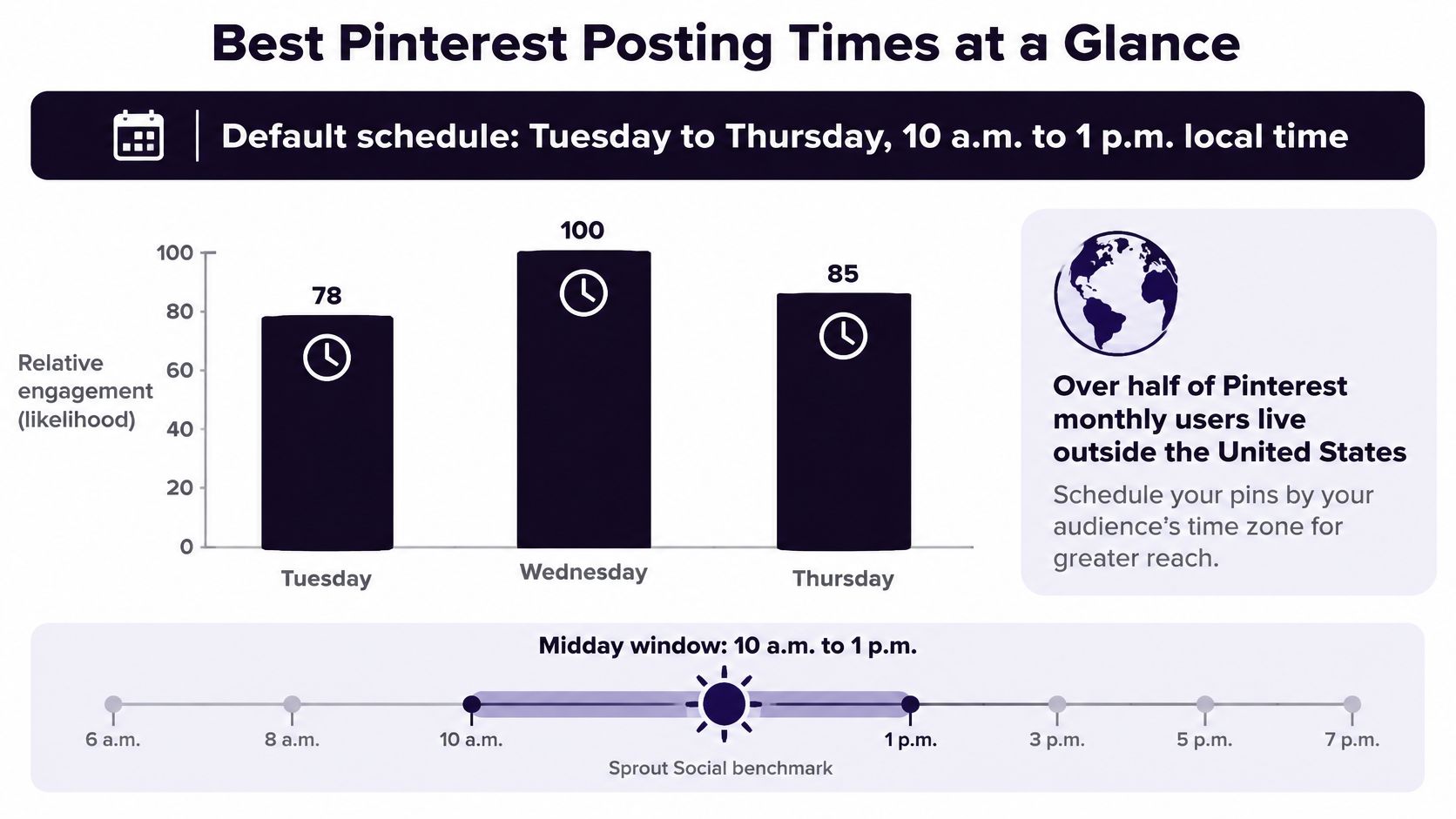
A Sprout Social benchmark summarized by SocialK looked at nearly 2 billion engagements across approximately 307,000 profiles and found Pinterest engagement strongest on weekdays in the late morning and midday, particularly Tuesday through Thursday from 10 a.m. to 1 p.m. local time. The same summary notes stronger Wednesday morning activity and Thursday afternoon pockets, so even that band is not flat. People often research ideas, products, recipes, and projects during daytime planning breaks, which is a different habit from scrolling a real-time feed.
How to read the published windows
These rows are not interchangeable. Days, hours, and time bases change from one publisher to the next.
| Source and year | Reported strongest window | Days | Time basis |
|---|---|---|---|
| Sprout Social benchmark | 10 a.m. to 1 p.m. | Tuesday to Thursday | Audience local time |
| Hootsuite (2025) | 12:00 p.m. | Tuesday and Friday | Clock time as published, zone not stated |
| Brandwatch (2025) | 8 to 11 a.m. and 2 to 4 p.m. | Weekdays, plus Saturday mornings | Clock hours as summarized, zone not stated |
| Tailwind (2025) | 8 to 11 p.m. | Not limited to one weekday | Users' local time zones |
| Marketing-Interactive citing Sprout Social (2023) | Tuesday 1 p.m.; Wednesday 1 to 3 p.m.; Thursday 12 to 2 p.m. | Tuesday to Thursday | Clock time in the 2023 citation |
| One large analysis | 10 p.m. to midnight | Not named by day | Local time |
| Buffer (2016, 1,577,234 Pins) | Most published Monday and Tuesday; highest engagement Monday, Saturday second | Monday, Tuesday, Saturday | Publishing volume and engagement, not one clock slot |
Hootsuite's 2025 data points to 12:00 p.m. on Tuesdays and Fridays. Brandwatch's 2025 summary lists 8:00–11:00 a.m. and 2:00–4:00 p.m. on weekdays, plus Saturday mornings. Tailwind's 2025 reporting places common peak activity at 8:00–11:00 p.m. in users' local time zones. Marketing-Interactive, citing a 2023 Sprout Social analysis of nearly 2 billion engagements across 400,000 social profiles, names Tuesday at 1:00 p.m., Wednesday from 1:00–3:00 p.m., and Thursday from 12:00–2:00 p.m.
Averages across mixed audiences set a starting hypothesis, not a rule. Shortlist three windows and test them: weekday morning, the 10 a.m. to 1 p.m. control, and evening. Hold the Pin topic, destination URL, image ratio, description quality, and audience geography steady, then read impressions, outbound-click rate, saves per impression, and assisted conversions over 7 or 30 days. Pins keep getting found after the publish hour, so a same-day score is not the whole story.
Why Pinterest Timing Studies Disagree
Generic timing advice assumes Pinterest behaves like a live feed, where one posting hour fits every account because everyone is online together. That assumption fails as soon as you line the studies up. Dash Social's review of Pinterest timing puts the conflict in plain view: one large analysis reports the strongest engagement from 10 p.m. to midnight local time, while another recommends Tuesday to Thursday from 10 a.m. to 1 p.m. local time. A single universal slot cannot survive that split.
The same gap shows up on other networks when people quote one "best hour" without naming the metric. Bruce and Eddy's Reels timing guide is a useful contrast, because short-form video really does live or die on a short attention window. Pinterest does not.
Three reasons the hours don't match
Metrics are not the same thing. Published recommendations rarely say whether they measured impressions, saves, outbound clicks, or comments. Those can peak at different hours. A window that wins on impressions can lose on clicks. If your goal is traffic to a product page, an impressions champion is the wrong winner.
Time bases are not the same clock. Some write-ups mean the audience's local time. Others never say whether the hour is local or a headquarters clock. The same "1 p.m." is a different moment in New York and in London.
Years and audiences moved. Buffer's 2016 analysis covered 1,577,234 Pins from 20,319 profiles. Monday and Tuesday together accounted for 32% of Pins, about 16% each, yet Monday led engagement from likes and repins, with Saturday a close second. Publishing volume was not audience response. That study is historical. Later summaries describe a much larger, more global base, so a 2016 peak is a clue, not a current rule.
People also save ideas before they act. The hour with the most discovery is not always the hour with the most clicks or conversions. It is still an open question whether a Pin should go live while people are active, or earlier so distribution can start before a planning moment. iHatePosting's practical guide to posting times is the right companion when you are comparing platforms that decay in hours with one that keeps ranking for weeks.
Practical rule: The best time is the window that wins on the metric you chose, measured in your audience's time zone. If two studies used different metrics, they are not in a fight. They answered different questions.
Timing Posts by Audience Segment and Time Zone
One headquarters hour is a weak plan once the audience is spread across countries. Pinterest did not stay a small U.S. beta. The Pinterest newsroom archive records the path: a closed beta in March 2010, about 10,000 users within nine months, then roughly 48.7 million global users by February 2013 in Reuters and comScore figures, and a Semiocast estimate of 70 million by July 2013. Monthly actives later hit 150 million in October 2016, 175 million by April 2017, and 250 million by September 2018. The company also said it had more than 200 million monthly users in 2018 and that over half lived outside the United States.

That history is why timing is an access strategy. A slot that is midday in your office can be early morning, or already evening, for the people you want to reach.
Give each segment its own control
Group followers by country and city, then anchor each group to its dominant zone. North America should be split. Eastern and Pacific time are three hours apart, so one "company midday" lands in two different parts of the day.
| Audience segment | Time-zone anchor | Starting window to test | Risk to watch |
|---|---|---|---|
| North American followers | Eastern and Pacific time | 10 a.m. to 1 p.m. local, Tuesday to Thursday | The same slot lands three hours apart across the two zones |
| European followers | Central European time | 10 a.m. to 1 p.m. local, then an evening test | No regional split in published benchmarks |
| Asia-Pacific followers | Local market time | A separate morning and evening test on local data | No regional split in published benchmarks |
| Gen Z and trend-led audiences | The market where the trend is emerging | Publish as demand appears, not only where followers already sit | Demand can spike outside follower hours |
| Global brand with several markets | One window per priority market | Stagger releases by market | Teams lose track without a shared calendar |
Published benchmarks do not break Europe or Asia-Pacific into their own hours. Do not invent a regional peak. Run the midday control in local time, add one evening test, and keep the result inside that segment until the numbers repeat. For several priority markets, stagger the releases and keep one shared calendar so every team can see every slot. You can build a consistent Pinterest posting routine without forcing every market onto the office clock.
Schedule for local time, and check each segment's result before you generalize it to the whole account.
Trend-led audiences are the exception. Their clock follows where demand shows up, which is a different problem from where current followers live.
Seasonal and Trend-Led Pinning Times
Two questions get mashed into one. The first is when people are online. The second is when the Pin needs to be live so it can be indexed and saved before demand arrives. Follower activity does not answer the second question.
Fortune's Pinterest Predicts coverage reports that the platform's forecasts analyze billions of searches and saves and activity from more than half a billion monthly users. The same reporting says trends are increasingly shaped by Gen Z, and that regional taste can swing hard. The Glamoratti aesthetic was nearly six times more popular among Gen Z users in Singapore than globally. Laced up was nearly five times more popular among Singaporean Gen Z than among users in Japan or Australia. A single global publish time is especially weak when the spike is regional.
Lead time is a planning rule, not a benchmark
The ranges below are planning rules of thumb. They are not figures from the timing studies. Use them to decide how early the first wave goes out, then confirm with search and save signals in the market you care about.
| Event or trend | Typical lead time | Release approach | Example |
|---|---|---|---|
| Holiday decor and gift guides | 4 to 6 weeks before the holiday | Early release, then a second wave near the date | Holiday table settings |
| Back-to-school planning | 4 to 6 weeks before term starts | Staggered by region and school calendar | Dorm room organisation |
| Wedding season | 2 to 3 months before peak season | Regional waves by climate and season | Outdoor ceremony ideas |
| Gen Z trend-led aesthetics | No fixed lead time; publish as the signal appears | Localise the creative by market, not only the caption | Glamoratti aesthetic in Singapore |
| Product launch | The launch week, then a follow-up wave one to two weeks later | Test immediately, then repeat | A product Pin to the same destination URL with a new image |
Evergreen seasonal Pins should be live early enough to collect saves before the event, with a second wave closer to the date for last-minute searches. Fast trends do not wait for a four-week lead. Publish when the signal appears, in the market where it is appearing, and change the image and the examples, not just the words. You can build a reusable content calendar that holds both waves so the early Pin is not forgotten when the rush week arrives.
Seasonal timing depends on the lead time of the event. Trend timing depends on where demand appears first.
Confirm Your Best Time With Analytics and a Test
Your account history beats any published average. A benchmark can suggest the first three windows. It cannot tell you whether your recipe Pins and your product Pins peak in the same hour.
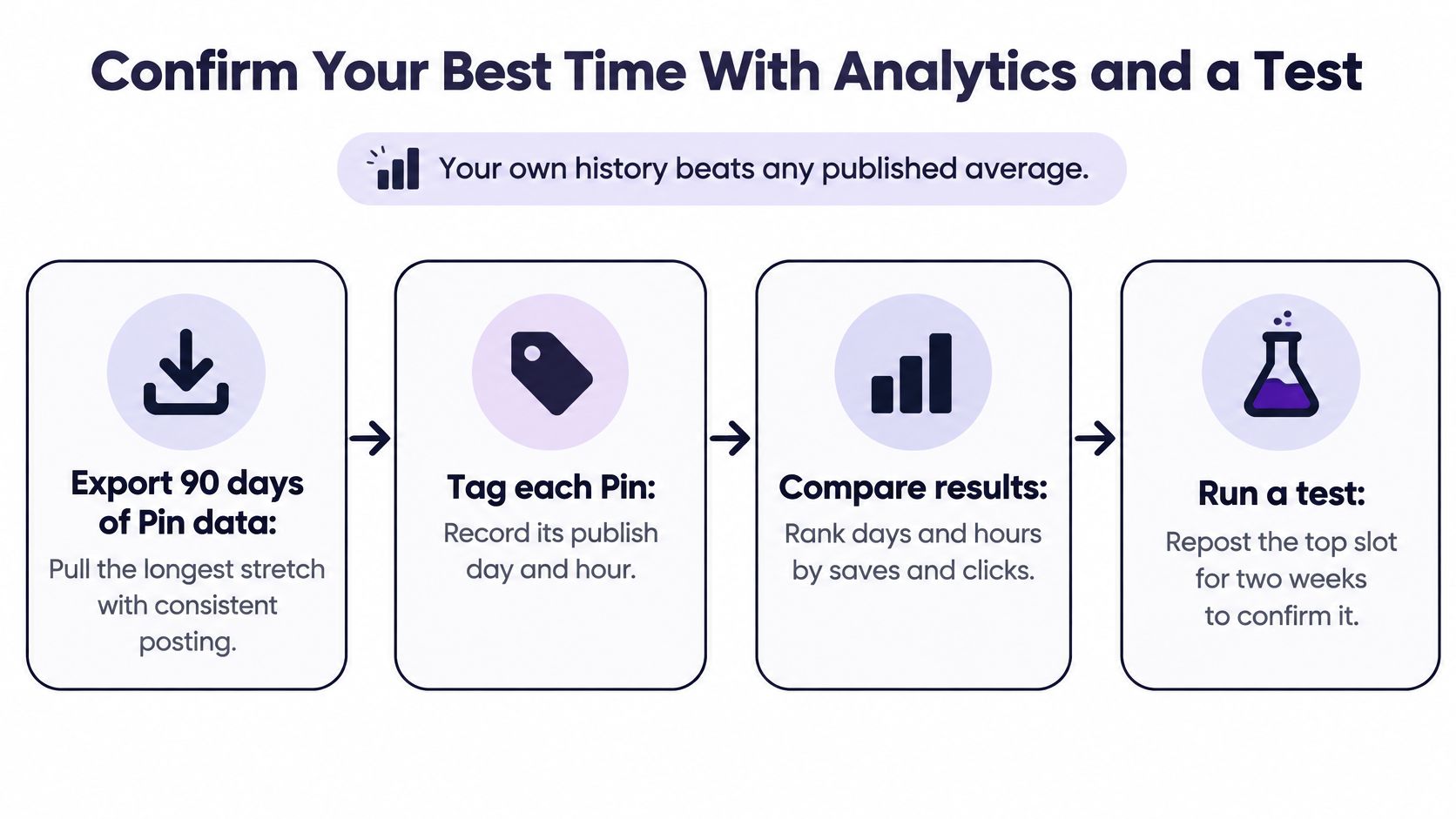
We include best-time recommendations derived from your own results, and we pair that with a structured schedule so the test does not depend on memory. A monthly, quarterly, or post-campaign audit is the right moment to rerun the comparison, especially after a seasonal push changes who shows up.
Read the last 90 days
- Export 90 days of Pin data, or the longest stretch where you posted on a steady rhythm.
- Tag each Pin with publish day and hour, converted to the main time zone of that audience segment.
- Group Pins into four windows: early morning, 10 a.m. to 1 p.m., afternoon, and 8 to 11 p.m.
- For each window, count Pins, then calculate saves per impression and outbound-click rate. Do not rank on raw saves. A busy window will always look bigger.
- Drop any window with fewer than about 10 Pins. Mark it untested. Do not call it a loser.
- Rank what remains by the goal you picked. Saves if you want distribution. Outbound clicks if you want site traffic.
Thin history is common. Use the published midday, morning, and evening windows as controls, and expect the ranking to take longer than one month. Do not fill the gaps with a generic hour.
Run the four-week confirmation
- Week one. Publish comparable Pins in three windows: morning, 10 a.m. to 1 p.m., and evening. Keep topic, destination URL, and image format constant.
- Weeks two and three. Keep the design and rotate the windows so each one appears on each day type. A Tuesday-only win is not a Thursday win.
- Week four. Compare windows on the goal metric. The gap should be large enough to change your calendar, and it should hold inside that time zone.
Decision rule. If one window leads in two consecutive measurement periods, make it the default for that segment. If the results are close, keep two windows and retest next quarter. Close scores usually mean the creative, not the clock, is doing the work.
Timing can improve early distribution. It cannot guarantee reach, followers, or sales. Pair the test with image quality, a clear description, and a destination that matches the Pin. A practical measurement framework for marketing teams keeps the goal metric stable so you are not switching from saves to clicks halfway through the month.
A short walkthrough of how to read Pin analytics sits well beside that export, before you lock a slot.
How to Apply Your Best Times in a Scheduler
A test is wasted if the winning hour never makes it onto the calendar. Work through this in one session, in the order you set a queue up.
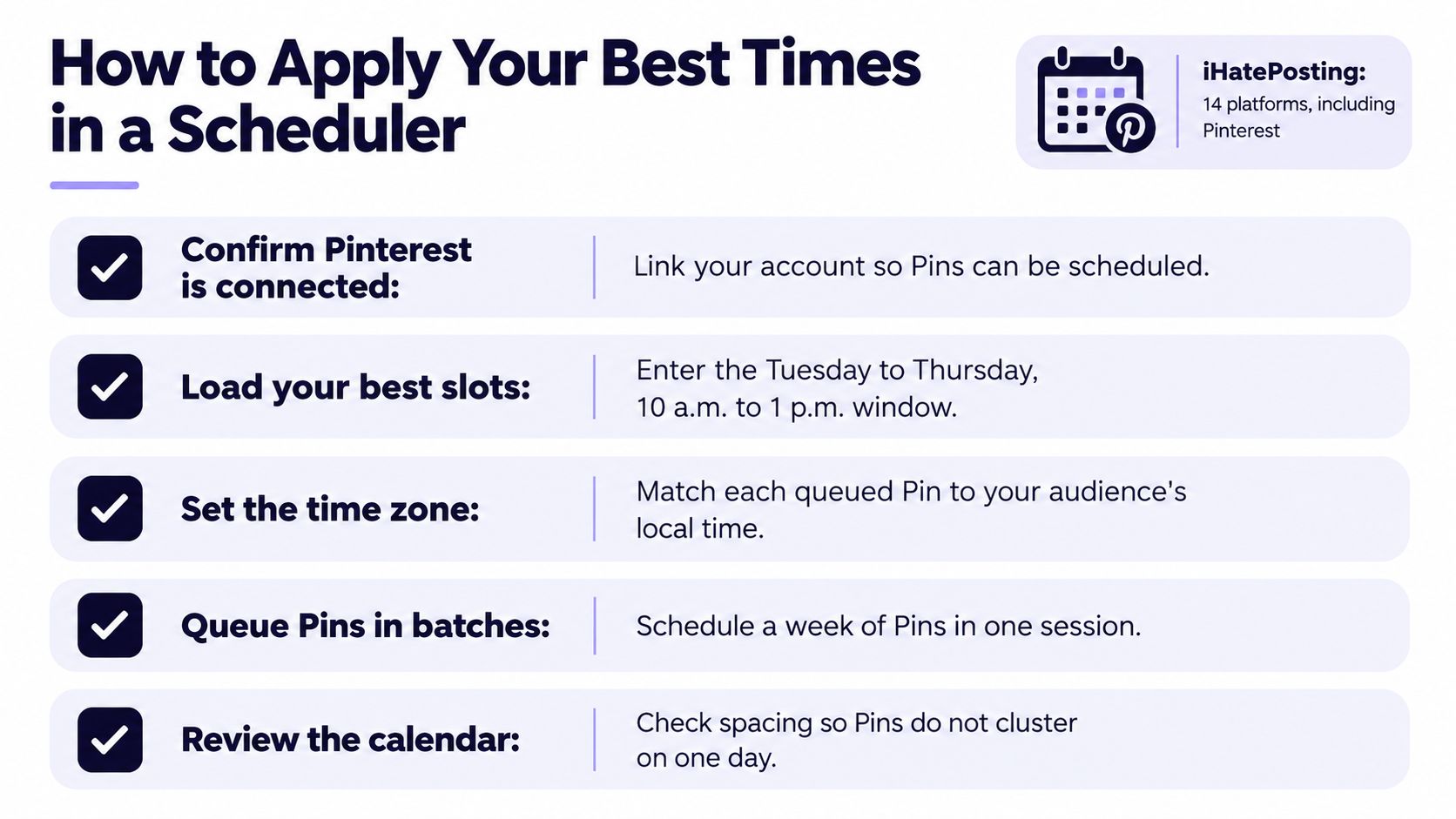
- Confirm Pinterest is connected. iHatePosting supports scheduling across 14 platforms, including Pinterest, so Pins sit on the same calendar as your other channels instead of in a separate tab.
- Create one slot per audience segment. Label it with the time zone, not with your office clock. Eastern and Pacific should be separate rows.
- Assign each Pin by job. Evergreen ideas go in the proven slot. Seasonal waves go in the early slot and the near-date slot you already planned.
- Change the image or the description slightly when the same idea is tested in two windows. Identical Pins in two slots look like duplicates and muddy the comparison.
- Use preview and pre-publish checks. Confirm the time and the destination link before the Pin enters the queue. A wrong link makes the click rate meaningless.
- Turn on automatic publishing, which runs 24/7, and set alerts so a failed Pin does not sit unnoticed until the test window is over.
- Review the calendar at the end of each test window. Move the winning slot into the main rhythm and retire the slot that lost twice.
A social media scheduler executes the schedule. It does not decide which window is right. That decision still comes from saves per impression and outbound clicks on your own Pins.
We help you plan and test Pinterest posting times from your own results, on a calendar you can realistically keep, across the channels you already run. Put your Tuesday to Thursday midday control on the queue, add the evening window as a rival, and let the next month of Pins settle the argument. Visit iHatePosting to schedule the test instead of guessing the hour.