Best Time to Post Saturday Instagram: Six Windows for 2026
12 min readSaturday InstagramInstagram posting timesInstagram analyticsInstagram scheduling
You scheduled the Reel you were proud of for noon on Saturday. The hook was sharp and the edit was clean, yet reach stayed thin and the comments never started. Instagram Insights told a plainer story. Your followers had already scrolled at 8 a.m., before brunch plans and errands pulled them offline. The noon post arrived after that first pass.
That mismatch is why the best time to post on Saturday on Instagram is not one shared hour. Benchmarks disagree because audiences, time zones, and formats disagree. The windows below are local-time starting points, not fixed rules. A 9:00 a.m. post in New York is still early morning in Los Angeles and already afternoon in London during summer. One global clock time serves one city and misses the others.
Treat every slot as a test you can confirm. If you already time campaigns from your own results, the same habit shows up in data-driven campaign timing for ecommerce marketers. The method at the end shows how to run two or three Saturday slots across two or three weeks and pick a default from your Insights, not from a generic chart.
1. Early Saturday Morning Window (7:00–8:00 AM local time)
Some people open Instagram with coffee, before the group chat fills with plans. A fitness coach, a travel editor, or a wellness brand can meet that quiet scroll while the feed is still thin. I would test 7:00–8:00 a.m. only when your own activity chart already leans early. It is a specialist window, not a safe default.
Hootsuite's 2025 analysis of more than 1 million Instagram posts from accounts across 118 countries put the strongest Saturday windows at 11:00 a.m. and around 5:00 p.m., and advised brands to avoid posting before 8:00 a.m., when activity was lowest. Use 7:15 a.m. as a contrast against one later hour, not as your only Saturday post.
Shift the clock with the audience. A 7:30 a.m. Pacific post is 10:30 a.m. on the East Coast. If your saves come from New York, a California laptop will publish too early for them.
How to run the early test
Say a run club wants members to save a Saturday route. Publish the Reel at 7:15 a.m. in the city where they live, then add a short Story with the same map.
- Schedule it the night before: A social media scheduler can send the post without you being awake.
- Hold the format still: Keep length and caption style steady for two or three Saturdays, then compare that post with a late-morning twin.
- Pair a Story: A 15-second Story gives the Reel a second chance after the first hour.
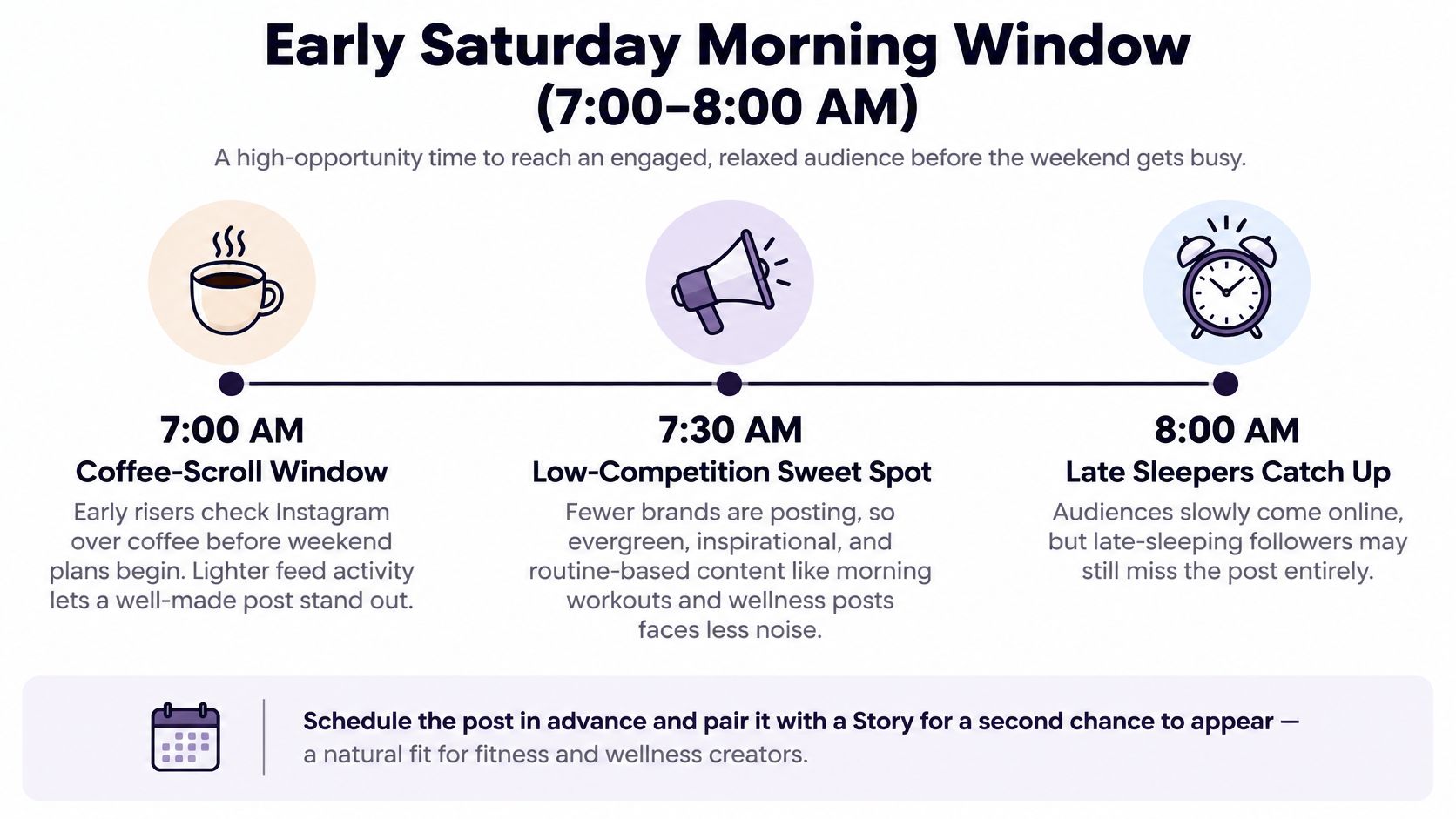
Practical rule: A quieter feed will not rescue a post if your followers are still asleep at 7:00 a.m. local time.
2. Mid-Morning Weekend Window (9:00–10:00 AM local time)
By 9:00 a.m. many people have eaten and started browsing without a deadline. Engagement often builds through the morning, which suits menus, guides, and other broad posts for a general following.

A neighborhood bakery can post a weekend menu carousel at 9:30 a.m. in the city's time zone. Slide one should name the offer, such as Saturday loaves gone by 1. Nearby followers save it, then share it before they leave the house. That is a better use of this hour than a hard sell aimed at people who are still half awake.
Check the professional dashboard before you lock the slot. The audience chart shows whether 9:00 a.m. is busy for your followers. Instagram timing tips from iHatePosting are a map. Your Insights are the decision.
- Lead the carousel: Put the value on slide one so a save does not depend on a swipe.
- Separate the cities: 9:00 a.m. in London is 4:00 a.m. in New York, so one publish time cannot serve both.
- Keep the test short: Two or three Saturdays of the same carousel format are enough to see if saves rise.
If the chart peaks later, do not force this hour because it feels productive to you.
3. Late Morning Window (10:00–11:00 AM local time)
Late morning is when a lot of people are awake, relaxed, and lining up errands. Casual browsing gives shopping, food, and local-event posts a fair chance to be seen without a work-day rush.
Adobe's social timing guidance reports an 8:00–11:00 a.m. Saturday window, while another Adobe summary gives 9:00 a.m.–4:00 p.m. HubSpot, in that same roundup, reports 12:00–3:00 p.m. as the peak window for 44% of marketers and 6:00–9:00 p.m. as a secondary window for 36%. This hour sits inside the morning range, and the marketer split is a reminder to test afternoon and evening too.
A ceramics shop can post a same-day studio open house at 10:30 a.m. local. Followers still have the afternoon free, so the offer can turn into a visit. A Reel needs a strong first frame, because a casual scroller decides in seconds.
If the event is today, say the time and the neighborhood in the first line. A pretty clip without the facts will not fill the room.
For a split audience, publish a second cut an hour later in the other region's local time. Do not stack both cities onto your own clock.
4. Lunchtime Window (12:00–1:00 PM local time)
Midday overlaps lunch and the start of afternoon plans. People check phones in a short pause, which fits quick recipes, short Reels, and captions they can finish in one glance.
Sociality.io's 12-month analysis of 335,210 organic Instagram posts found that 12:00–2:00 p.m. was the weakest Saturday period, with 48.5% of posts beating the account's own baseline. That is a real trade-off. Lunch can look busy on your phone and still be a softer slot than the evening for many accounts. Test it. Do not assume it.
Say a meal-kit brand posts a 20-second skillet Reel at 12:10 p.m. local, with the ingredient list in line one. The same idea as a 45-second story should run on a later Saturday so you can compare watch time, not just likes.
- Front-load the caption: The main message belongs in the first line, before the “more” cutoff.
- Match the pause: A tip someone can cook tonight beats a long origin story at noon.
- Plan the sequence: Carousel scheduling guidance for social media teams helps when the recipe needs slides instead of a Reel.
Noon in Chicago is 1:00 p.m. in New York and 10:00 a.m. in Los Angeles. Label the slot by the city you mean.
5. Mid-Afternoon Window (3:00–4:00 PM local time)
Mid-afternoon is when people come back from errands, kids' sports, or a late lunch and scroll without a purchase in mind. I would use 3:00–4:00 p.m. for questions and comments, not for a launch you need to spike.
Sprout Social's review of nearly 2 billion engagements across 307,000 global social profiles found that Saturday produces the lowest overall Instagram engagement of the week, and that Saturday engagement generally flatlines rather than forming a strong universal peak. A flat day means this hour will not rescue a major announcement. It can still carry lighter community posts if your own chart shows people around.
What to publish in a flat hour
A plant shop can ask, at 3:30 p.m. local, which pot color should return next month, then run the same poll in a Story. Early replies matter, so answer in the first half hour while the thread is still moving. Save product drops for a weekday window unless your Insights say otherwise.
- Start a conversation: Story polls and questions can carry into Sunday without asking for a sale.
- Reply while it is fresh: The first comments are the ones other followers still see in the preview.
- Check the calendar gap: Use your activity chart to find the best times to post before you give this hour a permanent slot.
Three o'clock in London is mid-morning on the U.S. East Coast. Do not call both of those “afternoon.”
6. Early Evening Window (6:00–7:00 PM local time)
After dinner plans, outings, or family time, people settle in and browse for longer. Entertainment, lifestyle, and personality posts fit this hour, including videos that need more than a glance.
Buffer's analysis of 9.6 million Instagram posts from more than 200,000 accounts, from January 2024 through December 2025, placed Saturday among the weakest days. Its best Saturday hour was 9:00 p.m., followed by 8:00 p.m. and 10:00 p.m., and all three stayed in the study's low-engagement tier. Six o'clock is earlier than that cluster. Test 6:30 p.m. against 8:30 p.m. before you decide the evening is “done” at dinner.
A small craft studio can share a process Reel at 6:15 p.m. local, when followers have time to watch the full clip. Behind-the-scenes footage that feels personal usually beats a polished ad in this slot. Then read Reel watch time, not only likes.

A longer video only wins here if people stay. If average watch time drops after a few seconds, shorten the cut before you blame the hour.
iHatePosting's guide to Instagram Reels timing is a useful companion when you compare a 15-second cut with a fuller process video. Six p.m. in New York is still 3 p.m. in Los Angeles, so a West Coast audience has not sat down yet.
7. Late Evening Window (8:00–9:00 PM local time)
Late evening catches people winding down on the couch, including night-owl followers and audiences a few zones behind you. Entertainment, nightlife, and event recaps fit the last scroll before bed. I would not put a deadline offer here if the store is already closed in that city.
A bar can post Saturday's lineup at 8:15 p.m. local for people still deciding where to go, or a recap if the goal is next week's ticket. Check the preview on a phone, because hashtags and line breaks that look fine on a laptop often collide at night.
Our visual calendar lets you queue that post earlier in the day, review it, and still have it publish while you are offline. Previews show the caption the way it will sit on a phone.
- Draft, then edit: Use AI-assisted drafting for a platform-specific caption and hashtag set, then rewrite anything that does not sound like the brand.
- Watch the next zone: 8:00 p.m. Eastern is 5:00 p.m. Pacific, so a “late” post is still late afternoon for the West Coast.
- Judge the format: A study of 2.6 million Instagram posts from 46,839 creators estimated that the best posting window beat the worst by only about 7.3%, and that format, including collaborations, could move results more than the clock.
If a late Reel fails, fix the opening frame before you hunt a new hour.
How the six Saturday Instagram posting windows compare
The first six slots form the standard Saturday comparison. Treat late evening as a special case for nightlife, entertainment, and event-led accounts rather than a default window. All times are local to the city being targeted. The Pacific-time column shows where a single post lands when scheduled for the listed Eastern window.
| Window | Local time | Eastern send reaches Pacific at | Best for | Main trade-off |
|---|---|---|---|---|
| Early Saturday Morning Window | 7:00–8:00 AM | 4:00–5:00 AM | Morning routines, workouts, wellness, and evergreen posts | Smaller audience; late risers may miss it |
| Mid-Morning Weekend Window | 9:00–10:00 AM | 6:00–7:00 AM | Lifestyle, product, and community posts; saveable carousels | Competes with other morning posts |
| Late Morning Window | 10:00–11:00 AM | 7:00–8:00 AM | Reels, shopping, food, local events, and promotions | High competition for attention |
| Lunchtime Window | 12:00–1:00 PM | 9:00–10:00 AM | Quick-read posts, recipes, tips, and short Reels | Short attention spans; some people may be offline |
| Mid-Afternoon Window | 3:00–4:00 PM | 12:00–1:00 PM | Polls, questions, Stories, and community discussion | Followers may be busy; reach may be lighter |
| Early Evening Window | 6:00–7:00 PM | 3:00–4:00 PM | Entertainment, longer Reels, storytelling, and behind-the-scenes posts | Competes with dinner and entertainment |
| Late Evening Window, special case | 8:00–9:00 PM | 5:00–6:00 PM | Nightlife, events, entertainment, and night-owl audiences | Smaller audience; some followers may not return until Sunday |
A city-specific audience can use the local column directly. A national account needs to check where that send lands elsewhere before treating the window as a single Saturday answer.
Turn Six Windows Into a Tested Saturday Routine
Pick two or three of these local windows, not all of them at once. For two or three Saturdays in a row, publish the same format in each slot, aimed at the same city. Then open Instagram Insights and compare reach, saves, and watch time. Saves and completed views tell you more than a like count from a small crowd. The slot that beats your own Saturday median becomes the default. The others stay in the test pile.
Review that default every month, and again after a major campaign, because follower habits move with seasons, launches, and new cities. We recommend that same monthly, quarterly, or post-campaign audit so the calendar does not freeze around a lucky week. Our scheduling uses your account's own data beside that plan, and it cannot promise reach, followers, or sales.
AI-powered drafting can write a first pass of platform-specific captions, hooks, and hashtags, which cuts the blank-page time on lighter Saturday posts. AI agents can then adapt, schedule, and publish those posts across channels, as long as a person still approves the cut. A Saturday Instagram scheduling platform keeps that calendar, the approvals, and the weekend posts in one place.
Creative size still matters once the hour is chosen. Sizing product photos for social ads keeps a Reel cover or carousel slide from getting cropped after you finally found a slot that works. Batch the posts, set one review time for comments, and measure the month by clarity and consistency rather than a single Saturday spike.
iHatePosting is a scheduler and planning workspace for mapping Saturday posts, tailoring captions by platform, and reading post-level reach alongside your own best-time suggestions. It fits creators and small teams who want a steady weekend rhythm without guessing a universal hour. Visit iHatePosting to set up the calendar and test your next local Saturday windows.